← Back to Practical Science and Public Health
Typhoid: How It Spreads and How to Prevent It
Your browser can't read text aloud. Try Chrome, Edge or Safari to hear the words.
WHY THIS MATTERS
Typhoid fever makes about 9 million people sick and kills about 110,000 every year around the world, most of them children in places without safe water and toilets. Many people believe typhoid and malaria come together from mosquitoes. They don't. Typhoid comes from swallowing germs from human waste. That means the ways to prevent it are completely different: clean water, toilets, handwashing and safe food.
KEY WORDS
- Bacteria: tiny living germs. Typhoid is caused by a bacterium called Salmonella Typhi.
- Faeces: human waste (poo). Typhoid germs leave the body in the faeces of an infected person.
- Contaminated: made dirty or unsafe by germs.
- Carrier: a person who feels healthy but still carries typhoid germs and can spread them.
- Antibiotic: a medicine that kills bacteria. Antibiotics don't work against malaria or viruses.
HOW TYPHOID SPREADS
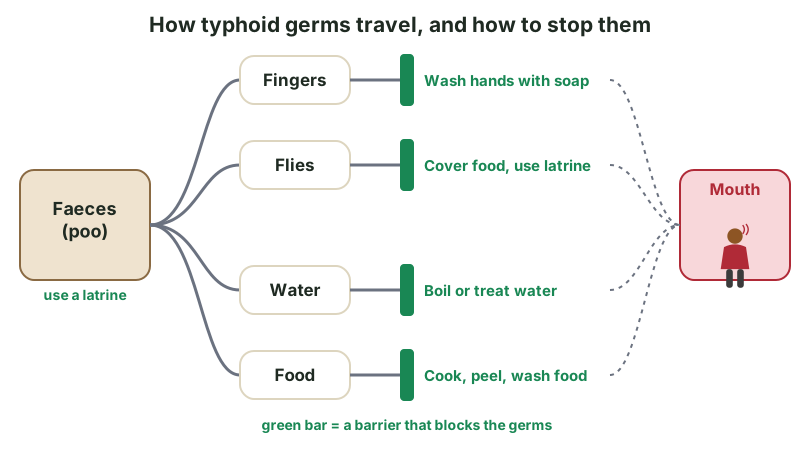
Typhoid follows a simple path, sometimes called the "faecal-oral" route: from one person's faeces to another person's mouth.
- Faeces get into water when people defecate in the open, near rivers or wells, or when latrines leak.
- Germs get onto hands if people don't wash with soap after using the toilet.
- Unwashed hands then touch food, cups or water containers.
- Flies can carry germs from faeces to food.
- Someone eats or drinks the contaminated food or water, and the germs multiply in their body.
SIGNS AND SYMPTOMS
Typhoid usually starts slowly, often 1 to 3 weeks after swallowing the germs:
- A high fever that keeps rising over several days and lasts a long time
- Headache, weakness and tiredness
- Stomach pain
- Constipation or diarrhoea
- Loss of appetite and nausea
- Sometimes a faint rash of rose-coloured spots
Without treatment, typhoid can cause serious problems such as a hole in the gut. Anyone with a long-lasting fever should see a health worker.
THE TESTING PROBLEM WHY SO MANY PEOPLE ARE TOLD THEY HAVE TYPHOID
In many clinics in East Africa, typhoid is tested with the Widal test. It's cheap and fast, but often wrong. In a study of 158 people with suspected typhoid in Dar es Salaam, Tanzania, the Widal test was positive in about 8 out of 10 of them, but a blood culture (the reliable test) showed that only about 1 in 10 actually had typhoid. That means most people told "you have typhoid" did not.
This matters because people take antibiotics they don't need. Unnecessary antibiotics cost money, cause side effects and help germs become resistant, so the medicines stop working when they're really needed. If you have a fever, make sure you're tested for malaria first, and ask the health worker whether a blood or stool culture is possible if typhoid is suspected.
IF A HEALTH WORKER DIAGNOSES TYPHOID
- Take all of the antibiotics exactly as prescribed, even after you feel better.
- Wash your hands with soap after using the toilet and before touching food.
- Don't prepare food for other people until a health worker says the infection has cleared. Some people keep carrying germs after they feel well.
MAKING DRINKING WATER SAFE
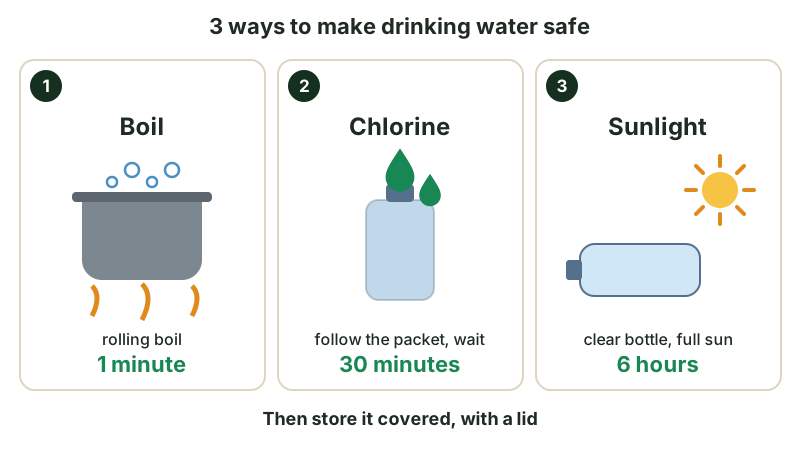
Water from rivers, ponds, open wells and even some taps can carry typhoid germs. Low-cost ways to make it safe:
- Boiling: bring water to a full, rolling boil (big bubbles) for at least one minute, then let it cool in a clean, covered container. This kills typhoid germs.
- Chlorine: use water treatment tablets or liquid chlorine sold for drinking water. Follow the instructions on the packet exactly, and wait at least 30 minutes before drinking.
- Sunlight (solar disinfection): fill clear plastic bottles of 2 litres or less with clear water and leave them lying in full sunlight for at least 6 hours, or for two days if it's cloudy. This works only with clear water, so let cloudy water settle and pour it through a clean cloth first.
- Safe storage: keep treated water in a container with a lid and a tap or narrow opening, so hands and cups don't go into the water.
HANDWASHING THE SIMPLEST MEDICINE
Wash hands with soap and water:
- After using the toilet or cleaning a child
- Before preparing food, before eating and before feeding a child
A simple "tippy tap", made from a jerrycan hung on a stick and tipped with a foot pedal, lets a family wash hands with very little water. If there's no soap, ash is better than water alone.
TOILETS AND SANITATION
- Use a latrine or toilet every time, and stop open defecation. If one family's faeces get into the water, the whole community is at risk.
- Build latrines at least 30 metres from water sources such as wells and boreholes, and downhill from them.
- Keep latrines covered to stop flies.
SAFE FOOD
- Cook food thoroughly and eat it while it's hot.
- Peel fruit yourself, or wash it in safe water.
- Avoid ice and drinks unless you know the water is safe.
- Boil milk unless it's pasteurised.
- Cover food to keep flies away.
- Remember the rule: "Boil it, cook it, peel it, or forget it."
THE TYPHOID VACCINE
A typhoid conjugate vaccine can protect children from 6 months of age with a single injection. Some countries in Africa have added it to routine childhood vaccinations. Ask your local health centre whether it's available.
REAL-LIFE CASE STUDY THE COOK WHO DIDN'T FEEL SICK
In New York over 100 years ago, a cook named Mary Mallon moved from family to family, and in each home people fell ill with typhoid. She felt perfectly healthy. Investigators discovered she was a carrier: typhoid germs lived in her body and passed onto the food she made, because she didn't wash her hands well after using the toilet. She became known as "Typhoid Mary". Her story shows why handwashing before preparing food matters, even for people who feel fine, and why someone who has had typhoid should be checked before cooking for others.
PRACTICE
Complete the sentences.
Drag a word into each gap, or tap a word and then tap the gap.
- Typhoid is caused by , not by a mosquito bite.
- Typhoid germs leave the body in a sick person's .
- Boil water at a rolling boil for at least one .
- Wash your hands with after using the toilet.
- A person who feels healthy but still spreads typhoid is called a .
✓ Check Your Understanding
Pick one answer for each question. You'll see the explanation straight away.
1. How do people catch typhoid?
2. A clinic tells a man he has both malaria and typhoid after a quick Widal test. Why should he be careful about this result?
3. Which is a safe way to treat river water for drinking at home?
4. When is it most important to wash your hands with soap to prevent typhoid?
5. Why should a latrine be built well away from a well or borehole?
You got out of 5. Excellent work! Read the explanations above, then try again.
Create a free account to tick off lessons and keep track of your progress.