← Back to Practical Science and Public Health
Malaria: Prevention, Warning Signs and Early Treatment
Your browser can't read text aloud. Try Chrome, Edge or Safari to hear the words.
WHY THIS MATTERS
Malaria is one of the biggest killers of children in Africa. In 2024 there were about 282 million malaria cases and 610,000 deaths worldwide, and around 95% of them were in Africa. Most of the people who die are children under five. In South Sudan, malaria causes about 5.5 million cases and more than 4,000 deaths every year, and about half of young children tested in 2023 had malaria parasites in their blood. Malaria can be prevented, and it can be cured if it's treated early.
KEY WORDS
- Parasite: a tiny living thing that lives inside another living thing and harms it. Malaria is caused by Plasmodium parasites.
- Rapid diagnostic test (RDT): a quick finger-prick blood test for malaria that gives a result in about 15 to 20 minutes.
- Severe malaria: malaria that has started to damage the body, such as the brain, blood or kidneys. It is an emergency.
- Prevention: actions that stop a disease before it starts.
HOW MALARIA SPREADS
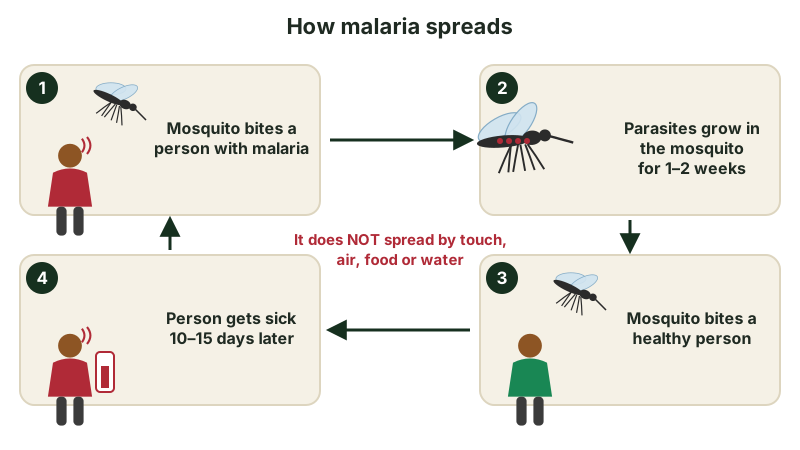
- An Anopheles mosquito bites a person who has malaria and sucks up parasites with the blood.
- The parasites grow inside the mosquito for about one to two weeks.
- The mosquito bites another person and passes the parasites into their blood.
- The parasites travel to the liver, multiply, then attack red blood cells.
Malaria does not spread through the air, by touching, or by sharing food. It can pass from a mother to her unborn baby and, rarely, through blood transfusions.
SIGNS AND SYMPTOMS
Early signs usually appear 10 to 15 days after an infected bite:
- Fever, which may come and go
- Chills and shivering
- Headache
- Sweating, body aches and tiredness
- In children: vomiting, poor feeding, being unusually sleepy or cranky
DANGER SIGNS GO TO A HEALTH FACILITY IMMEDIATELY
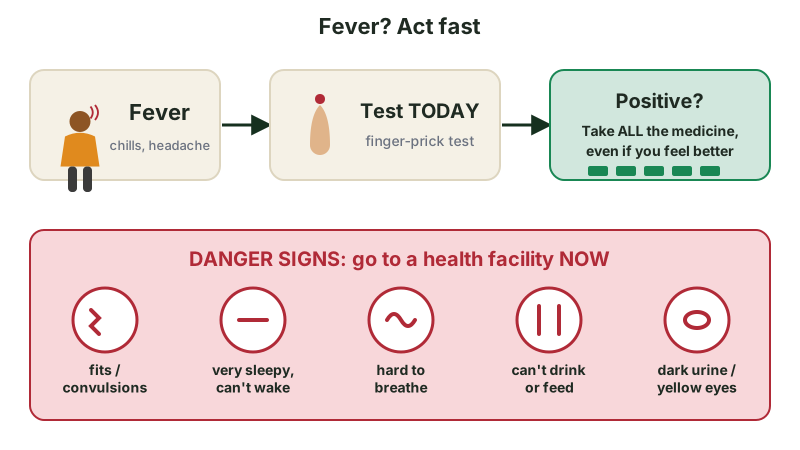
- Convulsions (fits)
- Very sleepy, confused or cannot be woken
- Difficulty breathing
- Unable to drink, eat or breastfeed, or vomiting everything
- Dark or very little urine
- Yellow eyes or skin
- Unusual bleeding
The most dangerous type of malaria can become severe and kill within 24 hours, so never wait to see if a fever goes away on its own.
IF SOMEONE HAS A FEVER TEST, THEN TREAT
- Get tested the same day, ideally within 24 hours of the fever starting. A health worker can do a finger-prick RDT or look at the blood under a microscope.
- Not every fever is malaria. Testing makes sure you get the right medicine, and if the test is negative, the health worker will look for other causes.
- If the test is positive, take the full course of the medicine the health worker gives you, even if you feel better after a day or two. Stopping early can let the malaria come back and helps the parasites become resistant to medicine.
- Don't use leftover tablets, share medicine or buy unlabelled medicine from the market. The wrong dose or fake medicine can be deadly.
- Keep a child with fever cool with light clothes, and give plenty of fluids or breastfeed more often on the way to the clinic.
PROTECTING THOSE MOST AT RISK
- Children under five: sleep under a treated net every night. In South Sudan, the R21 malaria vaccine is now part of routine childhood vaccinations. Babies get three doses at 5, 6 and 7 months, and a fourth at 18 months. Take children to the clinic for every dose.
- Pregnant women: malaria in pregnancy can cause anaemia, miscarriage and low birth weight. Go to antenatal care early, ask about preventive malaria medicine during pregnancy, and always sleep under a net.
- Visitors from areas without malaria: they have little or no immunity, so they get very sick. They should use nets and repellent, and travellers should see a doctor before travelling about preventive medicine.
COMMON MYTHS
- "Malaria comes from drinking dirty water or eating mangoes." False. It only comes from the bite of an infected mosquito (or from mother to baby).
- "Adults who've had malaria many times are immune." Partly false. Repeated infections give some protection, but adults can still get sick and pass malaria to mosquitoes, and protection fades if you move away for a while.
- "If the fever goes away, the malaria is gone." False. Fever can come and go. Only finishing the full treatment cures it.
- "Every fever is malaria and typhoid together." Often false. This is common in East Africa, but many people are told they have typhoid because of an unreliable test. See the next lesson.
REAL-LIFE CASE STUDY NYANDENG'S DAUGHTER
Nyandeng's three-year-old daughter developed a fever and stopped eating in the evening. Nyandeng remembered the health volunteer's advice: test within 24 hours. The next morning she took her daughter to the nearest health post. The RDT was positive. The health worker gave the correct medicine for the child's weight and explained how to give every dose. On the second day, the girl felt better and wanted to play, but Nyandeng finished the full course anyway. She also noticed their family net had a hole near the child's sleeping place and sewed it that night. A week later, her daughter was completely well. Acting early made the difference: she never developed danger signs.
PRACTICE
Complete the sentences.
Drag a word into each gap, or tap a word and then tap the gap.
- Malaria is caused by a tiny carried by mosquitoes.
- Early signs of malaria usually start 10 to 15 after an infected bite.
- Anyone with a fever should get a malaria the same day.
- Always take the course of medicine, even if you feel better.
- In South Sudan, babies get the first malaria vaccine dose at months.
✓ Check Your Understanding
Pick one answer for each question. You'll see the explanation straight away.
1. How does malaria spread from one person to another?
2. A child has had a fever since last night. What is the best thing to do?
3. Which of these is a danger sign that means a person with malaria needs a health facility immediately?
4. After two days of malaria medicine, a man feels much better. What should he do?
5. In South Sudan, at what ages do children receive the R21 malaria vaccine?
You got out of 5. Excellent work! Read the explanations above, then try again.
Create a free account to tick off lessons and keep track of your progress.