← Back to Practical Science and Public Health
How to Reduce Mosquitoes Around Your Home (Low-Cost Methods)
Your browser can't read text aloud. Try Chrome, Edge or Safari to hear the words.
WHY THIS MATTERS
You don't need expensive sprays or gadgets. The methods that work best are mostly free or low-cost: sleeping under a treated net, getting rid of standing water, and blocking the ways mosquitoes get into your house. Used together, they protect your family from malaria and other mosquito-borne diseases.
KEY WORDS
- Insecticide-treated net (ITN): a bed net treated with insecticide that kills or drives away mosquitoes that land on it. Long-lasting nets keep working for about three years.
- Indoor residual spraying (IRS): spraying insecticide on inside walls, usually done by health teams.
- Repellent: a cream or spray that stops mosquitoes from biting your skin.
- Eaves: the gap between the top of a wall and the roof, a common way for mosquitoes to get in.
METHOD 1 SLEEP UNDER A TREATED NET, EVERY NIGHT
This is the single most important step against malaria, because malaria mosquitoes bite late at night when people are asleep.
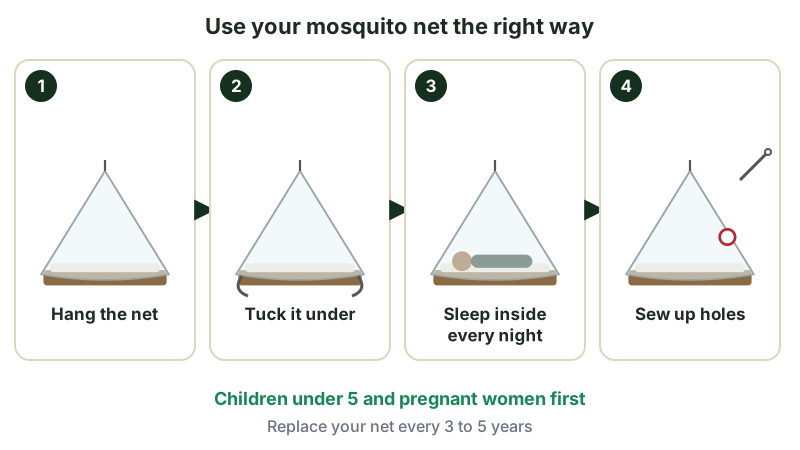
- Everyone should sleep under a net, especially children under five and pregnant women.
- Hang the net over the sleeping place and tuck the edges under the mattress or mat.
- Air a new net outside in the shade for a day before first use.
- Get into bed and close the net before it gets dark, and keep it closed during the day.
- Mend holes as soon as you see them, by sewing them closed or adding a patch. Even small holes let mosquitoes in.
- Wash it only when it's dirty, with mild soap and cool water, and dry it flat in the shade. Washing too often and drying in strong sun weakens the insecticide.
- Replace your net every three to five years, or sooner if it's badly damaged.
- Never use treated nets for fishing or to protect crops. The insecticide harms fish and the net no longer protects your family.
METHOD 2 REMOVE BREEDING SITES EVERY WEEK
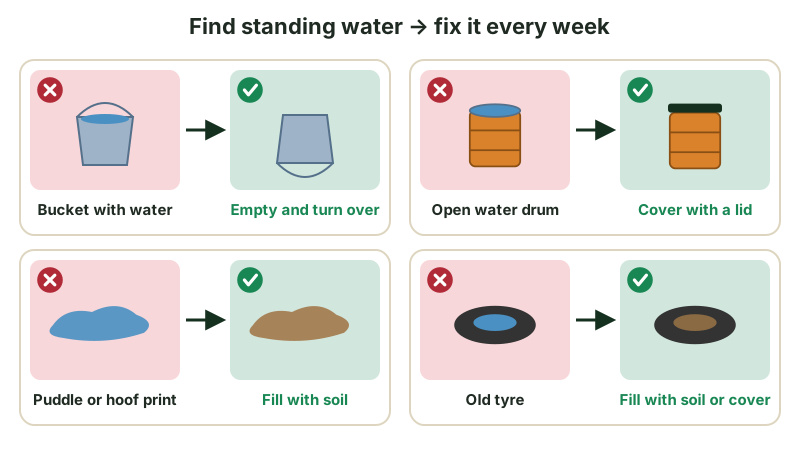
Mosquitoes need standing water to breed. Walk around your home once a week, especially during the rainy season:
- Empty, scrub and turn over buckets, basins, pots and old containers.
- Cover water storage drums and jerrycans tightly with a lid or cloth.
- Fill puddles, ruts and hoof prints near the house with soil or sand.
- Clear blocked drains so water flows away.
- Store old tyres under cover or fill them with soil, and collect plastic rubbish, bottles and tins.
- Change water in animal drinking troughs and flower vases at least once a week.
- For ponds or water you can't drain, local fish such as tilapia eat mosquito larvae.
METHOD 3 KEEP MOSQUITOES OUT OF THE HOUSE
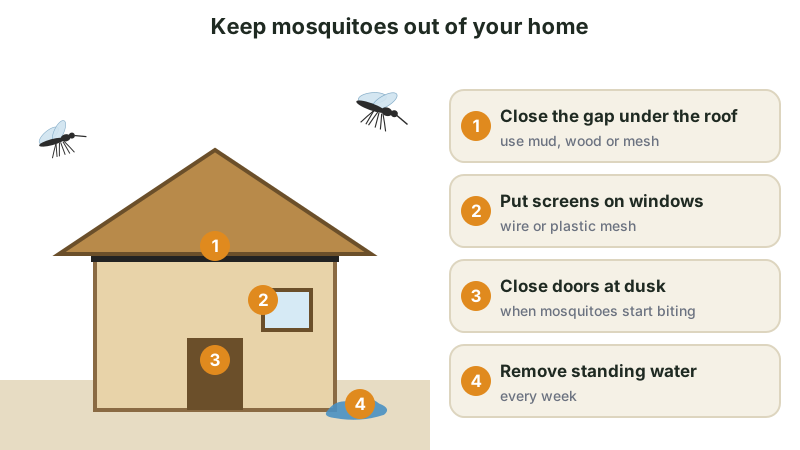
- Close the eaves gap between the wall and roof with mud, wood or mesh.
- Fit wire or plastic mesh screens on windows and vents.
- Close doors and windows from dusk, when mosquitoes start looking for people.
- Let health teams spray inside walls during indoor spraying campaigns, and don't repaint or plaster over the walls afterwards, or the insecticide stops working.
METHOD 4 PROTECT YOURSELF IN THE EVENING
- Wear long sleeves and long trousers when sitting outside after dark.
- Use an insect repellent containing DEET, picaridin or oil of lemon eucalyptus on exposed skin, following the label.
- Light-coloured clothes make it easier to see and brush off mosquitoes.
WHAT DOESN'T WORK (OR WORKS POORLY)
- Ultrasonic "mosquito repeller" devices and phone apps: studies show they don't stop bites.
- Eating garlic or taking vitamin B: no good evidence that they repel mosquitoes.
- Burning leaves, cow dung or mosquito coils indoors: smoke may chase some mosquitoes away for a while, but the smoke damages lungs, especially children's. If you use coils, use them outdoors or in well-ventilated places, never instead of a net.
- Cutting all the grass and bushes: tidiness helps a little, but mosquitoes breed in water, not grass. Removing water matters much more.
REAL-LIFE CASE STUDY A COMPOUND IN BOR
Deng's family of seven lives in a compound near the Nile. Two children had malaria twice in one rainy season. The local health volunteer visited and found three problems: the family had only two nets for seven people, one net had large holes, and water was collecting in a broken water drum and in cattle hoof prints near the huts.
The family took these low-cost steps:
- They collected free nets from the next distribution, so every sleeping place had one, and sewed up the torn net.
- They turned the broken drum over and filled the hoof prints with soil every few days during the rains.
- They packed mud into the eaves gap of the main hut.
- The children now go under their nets before dark.
By the end of the next rainy season, nobody in the family had needed malaria treatment. Their neighbours copied the same steps.
PRACTICE
Complete the sentences.
Drag a word into each gap, or tap a word and then tap the gap.
- The most important protection against malaria is sleeping under a treated every night.
- Check for and empty standing water at least once a .
- Dry a washed net in the , not in strong sun.
- Close the gap between the wall and roof, called the .
- Children under five and women most need to sleep under nets.
✓ Check Your Understanding
Pick one answer for each question. You'll see the explanation straight away.
1. Why is sleeping under a treated net so effective against malaria?
2. Your net has a small hole. What should you do?
3. Which of these is a breeding site for malaria mosquitoes?
4. A neighbour wants to buy an ultrasonic mosquito repeller instead of using nets. What would you tell them?
5. Health workers have just sprayed the inside walls of your house. What should you avoid doing?
You got out of 5. Excellent work! Read the explanations above, then try again.
Create a free account to tick off lessons and keep track of your progress.