← Back to Practical Science and Public Health
The Mosquito Life Cycle: Where Mosquitoes Come From
Your browser can't read text aloud. Try Chrome, Edge or Safari to hear the words.
WHY THIS MATTERS
Mosquitoes kill more people than any other animal, because they carry diseases such as malaria, dengue and yellow fever. But for most of its life a mosquito cannot fly or bite: it lives in water. If you understand its life cycle, you can stop mosquitoes before they ever reach your home.
KEY WORDS
- Life cycle: the stages an animal goes through from birth to adult.
- Larva (plural larvae): the young, worm-like stage that lives in water. People sometimes call them "wigglers".
- Pupa (plural pupae): the resting stage in water, when the larva changes into an adult.
- Breeding site: any water where mosquitoes lay eggs, from a pond to a bottle cap.
- Vector: a living thing that carries a disease from one person or animal to another.
THE FOUR STAGES
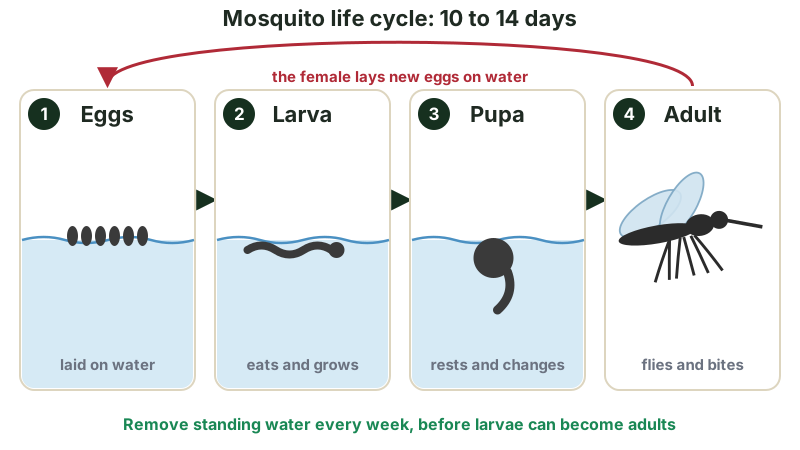
- Egg. A female lays a batch of 50 to 200 eggs on the surface of water. Malaria mosquitoes lay their eggs one at a time, and each egg has tiny floats on its sides.
- Larva. The egg hatches into a larva that lives in the water, eats tiny bits of food and breathes air at the surface. It sheds its skin four times as it grows.
- Pupa. The larva becomes a pupa. It does not eat. Inside, its body is changing into an adult mosquito.
- Adult. The adult breaks out of the pupa, rests on the water for a moment while its wings dry, and flies away.
From egg to flying adult usually takes 10 to 14 days for malaria mosquitoes, and can be faster in hot weather. That's why emptying or removing standing water once a week breaks the cycle: the young mosquitoes die before they can fly.
ONLY THE FEMALE BITES
Male mosquitoes feed on plant juices and nectar. Only females bite, because they need the protein in blood to make their eggs. After a blood meal, a female rests for a few days in a dark, sheltered place while her eggs develop, then looks for water to lay them. She can repeat this many times in her life, and each time she bites, she can pick up or pass on a disease.
THREE KINDS OF MOSQUITO TO KNOW
- Anopheles carries malaria. It usually bites in the late evening and at night, often indoors. Its larvae prefer clean, sunlit, shallow water such as puddles, hoof prints, tyre tracks, rice fields and the edges of streams. At rest, the adult sits with its body tilted, bottom in the air.
- Aedes carries dengue, yellow fever, chikungunya and Zika. It bites mainly in the daytime and breeds in small containers: buckets, old tyres, water jars, flower pots and plastic rubbish. It has black-and-white striped legs.
- Culex is the common night-time "buzzing" mosquito. It breeds in dirty water such as blocked drains and latrines, and can spread diseases such as lymphatic filariasis (elephantiasis).
HOW TO SPOT MALARIA MOSQUITO LARVAE
Scoop some water from a puddle into a clear cup or a white bowl and look closely.
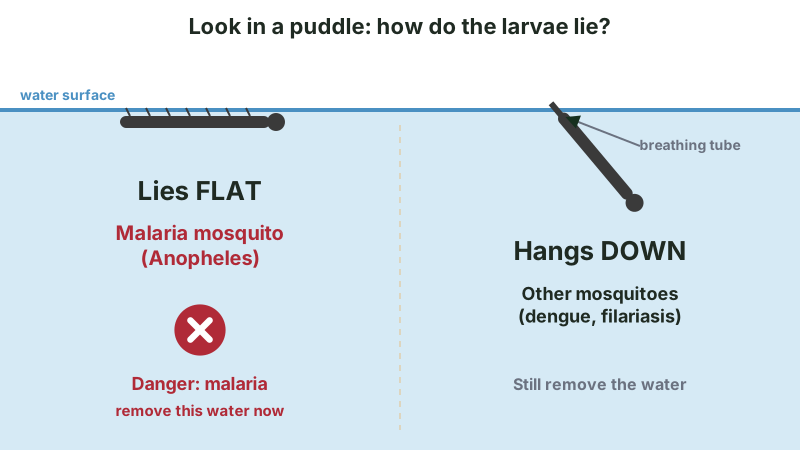
- Anopheles larvae lie flat, parallel to the water surface, like a floating stick.
- Most other mosquito larvae hang down at an angle from the surface, breathing through a tube at their tail.
If you find larvae lying flat, malaria mosquitoes are breeding close to your home.
HOW FAR DO MOSQUITOES FLY
Malaria mosquitoes usually stay within about 2 km of where they hatched. That's good news: if a whole village or neighbourhood removes breeding sites together, it can make a real difference. One household alone helps, but a community helps much more.
REAL-LIFE CASE STUDY THE SCHOOL WATER TANK
At a primary school, teachers noticed many children were sick with malaria after the rainy season started. A science class searched the school grounds with white bowls. They found larvae in a leaking water tank overflow, in tyre ruts by the gate, and in old containers behind the kitchen. The class drained the overflow into a soak pit, filled the ruts with soil and gravel, and collected the containers. They repeated the search every Friday. After a few weeks, staff and pupils noticed far fewer mosquitoes in the classrooms in the evenings, and the class reported their findings to the local health office.
PRACTICE
Complete the sentences.
Drag a word into each gap, or tap a word and then tap the gap.
- A mosquito lays its eggs on .
- The worm-like young stage of a mosquito is called a .
- The stage that does not eat while it changes into an adult is the .
- Only the mosquito bites.
- The mosquito that carries malaria is called .
✓ Check Your Understanding
Pick one answer for each question. You'll see the explanation straight away.
1. What are the four stages of the mosquito life cycle, in order?
2. Why do female mosquitoes bite people?
3. Why does emptying standing water once a week help so much?
4. You scoop water from a puddle and see larvae lying flat along the surface, like little floating sticks. What does this tell you?
5. Which mosquito mostly bites during the day and breeds in small containers such as buckets and old tyres?
You got out of 5. Excellent work! Read the explanations above, then try again.
Create a free account to tick off lessons and keep track of your progress.