← Back to Religion and Culture in Africa
Religion in Africa Today: Blending Old and New Faith
Your browser can't read text aloud. Try Chrome, Edge or Safari to hear the words.
WHY THIS MATTERS
Africa is now one of the most religious places on earth. In the Pew Research Center's survey of 19 sub-Saharan countries, in many of them about nine in ten people or more said religion is very important in their lives. Faith shapes how people vote, how they settle disputes, how they treat illness and how communities rebuild after war. To understand modern Africa, you need to understand its faith.
KEY WORDS
- Syncretism: blending beliefs and practices from different religions.
- Pentecostal: a type of Christianity that emphasises the Holy Spirit, healing, lively worship and personal experience of God.
- Prosperity gospel: the teaching that faith and giving to the church will bring wealth and health.
- Interfaith: involving people of different religions.
- Secular: not connected with religion.
BLENDING OLD AND NEW
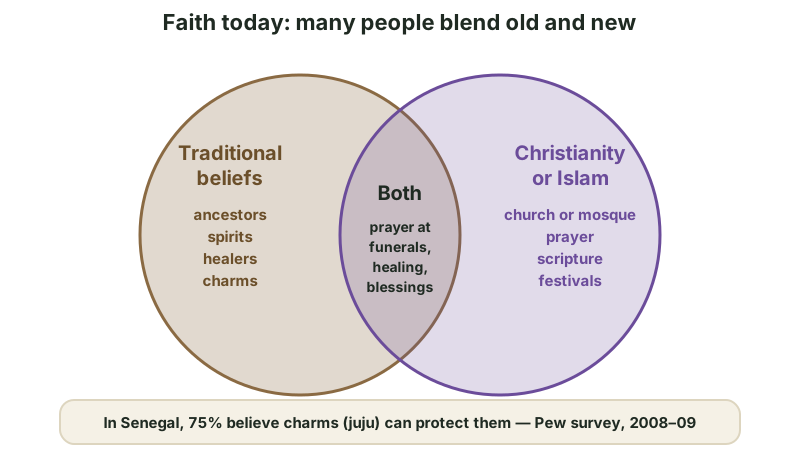
Many Africans see no conflict between going to church or mosque and honouring ancestors, consulting a traditional healer or wearing a protective charm. A person might pray in church on Sunday, then pour a drink for the ancestors at a family ceremony. Funerals and weddings often mix Christian or Muslim prayers with traditional customs. Some religious leaders welcome this, saying faith should be at home in African culture; others condemn it and ask believers to choose.
THE CHURCH BOOM
Since the 1970s, Pentecostal and charismatic churches have spread rapidly across Africa, from Nigeria and Ghana to Kenya, Uganda and South Africa. Their lively music, prayers for healing and miracles, use of local languages and young leaders appeal to many people, especially in fast-growing cities. Some have become very large, with television channels and branches abroad.
THE PROSPERITY GOSPEL DEBATE
Some churches teach that giving money to the church will bring blessings of wealth and health. Supporters say this message gives hope and encourages hard work. Critics, including many African church leaders, say it can be used to take money from poor people, and that some preachers become very rich while their members stay poor. It is one of the most debated issues in African Christianity today.
RELIGION AND PUBLIC LIFE
- Peace and reconciliation: churches and mosques often help mediate conflicts and support victims of war.
- Health and education: faith groups run many schools and hospitals across Africa.
- Politics: politicians often seek the support of religious leaders, and religion can unite or divide voters.
- Living together: in many countries, Christians and Muslims live side by side, marry each other and share celebrations. In some places, though, religion has become mixed up with violent conflict.
YOUNG AFRICANS AND FAITH TODAY
Many young Africans remain deeply religious, often joining newer churches or Islamic movements. Others are questioning religion, especially online, and some, in Africa and among Africans living abroad, are rediscovering traditional spirituality as part of their cultural identity. Cities, the internet and education are all changing how people practise and talk about faith.
REAL-LIFE CASE STUDY FAITH IN SOUTH SUDAN
South Sudan became independent in 2011 after decades of war. Churches played a major role during and after the conflict. Church leaders spoke out for peace, organised meetings between rival communities and provided food, schools and health care when the state could not. The South Sudan Council of Churches, which brings together different Christian churches, has been involved in efforts to promote peace and reconciliation.
At the same time, traditional beliefs remain important. Many South Sudanese Christians still give cattle in marriage, respect the role of spiritual leaders such as the Dinka masters of the fishing spear, and keep traditional ceremonies at funerals. Faith in South Sudan, like much of Africa, is both new and very old at once.
PRACTICE
Complete the sentences.
Drag a word into each gap, or tap a word and then tap the gap.
- Blending beliefs from different religions is called .
- Christianity that emphasises the Holy Spirit and healing is called .
- The teaching that giving to the church brings wealth is the prosperity .
- Involving people of different religions is described as .
- South Sudan became independent in the year .
✓ Check Your Understanding
Pick one answer for each question. You'll see the explanation straight away.
1. What does syncretism mean?
2. In Pew's survey of 19 sub-Saharan countries, how important did people say religion was?
3. Why have Pentecostal and charismatic churches grown so fast in Africa?
4. What is a main criticism of the prosperity gospel?
5. How have churches contributed in South Sudan?
You got out of 5. Excellent work! Read the explanations above, then try again.
Create a free account to tick off lessons and keep track of your progress.