← Back to Religion and Culture in Africa
Were Christianity and Islam Imposed on Africa? The Case For and Against
Your browser can't read text aloud. Try Chrome, Edge or Safari to hear the words.
THE QUESTION
Today, most Africans are Christian or Muslim. Yet only a few generations ago, most people south of the Sahara followed the religions of their ancestors. Many people ask: is it really believable that a whole continent freely abandoned its own beliefs and embraced religions from far away? Or were these faiths forced on Africa by conquerors, slave traders and colonial rulers?
This essay sets out the strongest case for imposition, then the strongest case against, then looks at what the evidence suggests. You can decide for yourself.
PART 1 THE CASE THAT THEY WERE IMPOSED
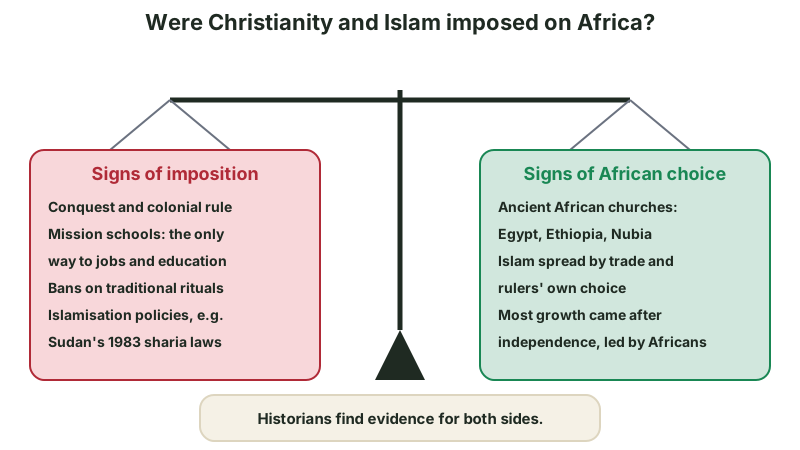
Conquest came first in many places. Arab armies conquered Egypt and North Africa in the 7th century. Under Muslim rule, non-Muslims usually paid a special tax called the jizya, which gave people a strong financial reason to convert over the generations. In the 1800s, jihads in West Africa, such as the one that created the Sokoto Caliphate, spread Islam partly by war.
The cross followed the flag. In the colonial era, missionaries often arrived alongside, or just ahead of, colonial rule. A famous saying, often attributed to Kenya's Jomo Kenyatta and also to Desmond Tutu, puts it sharply: "When the missionaries came to Africa, they had the Bible and we had the land. They said, let us pray. We closed our eyes. When we opened them, we had the Bible and they had the land."
Schools came with conditions. In many colonies, mission schools were almost the only way to learn to read, get a job as a clerk or teacher, or rise in society. Often, to attend, children had to be baptised and take a new "Christian" name. This was pressure, even if no one was physically forced.
Traditional religion was attacked. Many missionaries called African beliefs "pagan" or "devil worship". Converts were told to destroy shrines, stop honouring ancestors and give up customs such as polygamy. Colonial governments passed laws against some traditional practices, labelling them "witchcraft".
Slavery left deep wounds. Both the Atlantic slave trade, run largely by Christian Europeans, and the slave trades across the Sahara and the Indian Ocean, run largely by Muslim traders, tore millions of Africans from their homes. Enslaved people were often pressured or forced to adopt their owners' religion.
The pattern continued after independence. In Sudan, governments in Khartoum pushed Islamic law and Arabic culture onto the south, especially with the 1983 September Laws. For many South Sudanese, this was imposition within living memory.
Seen this way, it is hard to call the spread of these religions a free choice.
PART 2 THE CASE AGAINST
African Christianity is older than European colonialism by over a thousand years. Egypt's Coptic Church, Ethiopia's Orthodox Church from the AD 330s and the Christian kingdoms of Nubia from the 540s were African, not European, creations. Ethiopia was never a European colony, apart from a brief Italian occupation from 1936 to 1941, yet it remained Christian.
Islam often spread peacefully. In West Africa and along the Swahili coast, Islam came mainly with traders and scholars. Rulers such as those of the Mali Empire chose it, and Timbuktu became one of the world's great centres of Islamic learning. Africans helped spread Islam, they weren't only receivers of it.
Some African rulers chose Christianity themselves. In the early 1500s, King Afonso I of Kongo ruled as a Christian king, wrote letters to the King of Portugal as a fellow monarch, and sent his son Henrique to Europe, where he became a bishop.
The biggest growth came after colonialism. In 1900, after decades of missionary work, there were only about 7 million Christians in sub-Saharan Africa. Most of the growth to around 470 million by 2010 came in the 20th century, much of it after independence, when Europeans had left and Africans led the churches. If Christianity depended on colonial power, it should have shrunk when that power ended. Instead it grew faster.
Africans created their own churches, sometimes against colonial rulers. African-led churches broke away from mission control. Simon Kimbangu, a Congolese preacher, started a movement in 1921 that the Belgian colonial authorities saw as a threat. They jailed him, and he died in prison. His followers founded the Kimbanguist Church, now one of Africa's largest independent churches.
Africans had their own reasons. Research among the Dinka of South Sudan found that early missionaries won few converts, partly because they demanded a complete break with traditional religion. Large-scale conversion came decades later, during the civil wars. According to the scholar Jesse Zink, many Dinka felt their traditional divinities had not helped them in the crisis, while churches offered education, health care and hymns in the Dinka language. Local Dinka church leaders, cut off from foreign church officials by the war, adapted Christianity to Dinka life. This was a choice made under terrible pressure, but it was the Dinka's own choice.
PART 3 NOT ABANDONED, BUT BLENDED
Here the question itself may need rethinking. It assumes Africans either kept their old religions or abandoned them. Large surveys suggest that, for many, neither is true.
In a 2008 to 2009 survey of 19 sub-Saharan countries, the Pew Research Center found that many people who are deeply committed Christians or Muslims also keep traditional beliefs and practices:
- In 14 of the 19 countries, more than 30% of people said they sometimes consult traditional healers.
- In Senegal, 75% said they believe that charms (juju) and other sacred objects can protect them.
- In four countries, half or more of the people believed that sacrifices to ancestors or spirits can protect them from harm.
- In most countries, at least 30% believed in reincarnation.
So the instinct that a whole continent could not simply drop its beliefs is supported by evidence, but in an unexpected way. Many Africans didn't drop their old beliefs; they combined them with the new religions.
CONCLUSION
The evidence suggests that "imposed" is part of the truth, but not all of it. Conquest, colonial power, unequal schooling, slavery and, in Sudan, state Islamisation policies all pushed Africans towards Christianity and Islam. But Africans also chose these faiths, sometimes centuries before Europeans arrived, spread them themselves, built their own churches and mosques, and reshaped them with African music, languages and beliefs. Today, sub-Saharan Africa is home to more Christians than any other region of the world, about 697 million in 2020 according to Pew, and Africa is one of the great heartlands of Islam.
Perhaps the best word is not "imposed" or "chosen", but "transformed": Africans transformed these religions as much as the religions transformed Africa. Historians, theologians and Africans themselves still debate where the balance lies. What do you think?
PRACTICE
Complete the sentences.
Drag a word into each gap, or tap a word and then tap the gap.
- A special tax paid by non-Muslims under early Muslim rule was called the .
- The Congolese preacher jailed by Belgian colonial authorities was Simon .
- Ethiopia's ancient church is the Ethiopian Tewahedo Church.
- Combining traditional beliefs with Christianity or Islam is often called .
- Most growth of Christianity in Africa came after .
✓ Check Your Understanding
Pick one answer for each question. You'll see the explanation straight away.
1. Which of these is evidence used to argue that Christianity was imposed on Africa?
2. Which fact challenges the idea that Christianity in Africa simply came from European colonialism?
3. Why is it significant that Christianity grew fastest after independence?
4. What did the Pew survey of 19 African countries suggest about traditional beliefs?
5. According to research among the Dinka of South Sudan, why did many Dinka become Christians during the civil wars?
You got out of 5. Excellent work! Read the explanations above, then try again.
Create a free account to tick off lessons and keep track of your progress.