← Back to Religion and Culture in Africa
How Christianity and Islam Came to Africa: A Timeline
Your browser can't read text aloud. Try Chrome, Edge or Safari to hear the words.
WHY THIS MATTERS
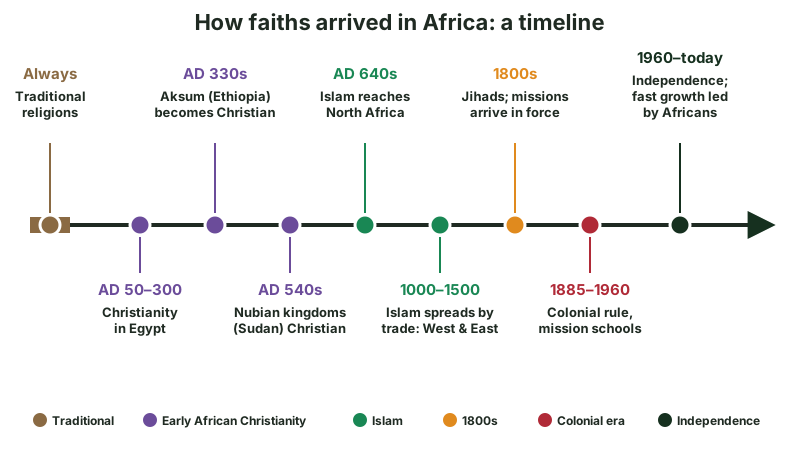
Many people assume Christianity arrived in Africa with European missionaries in the 1800s, and that Islam came only by conquest. The real story is longer and more surprising. Christianity reached North and East Africa almost 2,000 years ago, before it reached much of Europe. Islam arrived in some places by conquest and in others through traders and scholars. Knowing this timeline helps you judge the big question in the next lesson: were these religions imposed, or chosen?
KEY WORDS
- Missionary: a person sent to spread a religion.
- Convert: to change from one religion to another, or a person who has done so.
- Jihad: an Arabic word meaning "struggle". It can mean a personal spiritual struggle, and in history it was also used for wars fought in the name of Islam.
- Colonialism: when a foreign power takes control of a territory and its people.
- Independence: when a colony becomes a self-governing country.
ANCIENT AFRICAN CHRISTIANITY
- Egypt: Christianity spread in Egypt in the first centuries after Christ. Alexandria became one of the great centres of the early Church, and Egypt's Coptic Church is one of the oldest in the world.
- North Africa: some of the most important early Christian thinkers were Africans, including Augustine of Hippo, born in AD 354 in what is now Algeria.
- Ethiopia: in the AD 330s, King Ezana of Aksum adopted Christianity. The Ethiopian Orthodox Tewahedo Church has continued ever since, and Ethiopia kept its Christian identity for more than 1,600 years.
- Nubia (today's Sudan): the Nubian kingdoms became Christian in the 6th century. The king of Nobadia converted officially in AD 543. These Christian kingdoms lasted for centuries, with churches and cathedrals along the Nile.
HOW ISLAM ARRIVED
- An early welcome: around AD 615, some of the Prophet Muhammad's first followers fled persecution in Mecca and were sheltered by the Christian king of Aksum in Ethiopia. Africa's link with Islam began with protection, not conquest.
- Conquest in the north: in the AD 640s, Arab Muslim armies conquered Egypt and then spread across North Africa. Over the following centuries, most people there gradually became Muslim.
- A long peace with Nubia: the Nubians defeated Arab invasions in AD 641 and 652, and the two sides signed a treaty, the baqt, which kept peace and trade going for around 500 years.
- Trade and scholarship in West Africa: Islam spread across the Sahara with camel caravans of traders. Rulers of the Ghana and Mali empires adopted it. Mansa Musa of Mali made a famous pilgrimage to Mecca in 1324, and Timbuktu became a great centre of Islamic learning.
- The Swahili coast: on the East African coast, trade across the Indian Ocean brought Islam to towns like Kilwa, Mombasa and Zanzibar, creating the Swahili culture.
THE 1800s: JIHADS AND MISSIONS
- In West Africa, Islamic reform movements led by scholars such as Usman dan Fodio, who launched a jihad in 1804 and founded the Sokoto Caliphate in today's Nigeria, spread Islam further, partly by war.
- European Christian missionaries arrived in large numbers, opening churches, schools and hospitals.
- Earlier, some African rulers had chosen Christianity themselves: King Afonso I of Kongo, in today's Angola and DR Congo, ruled as a Christian king in the early 1500s, and his son Henrique became one of the first African Catholic bishops.
THE COLONIAL ERA (ABOUT 1885 TO 1960)
After the Berlin Conference of 1884 to 1885, European powers divided most of Africa between them. Missionaries often worked alongside colonial governments, and mission schools became the main way to get an education and a job in the colonial system.
AFTER INDEPENDENCE AFRICAN-LED GROWTH
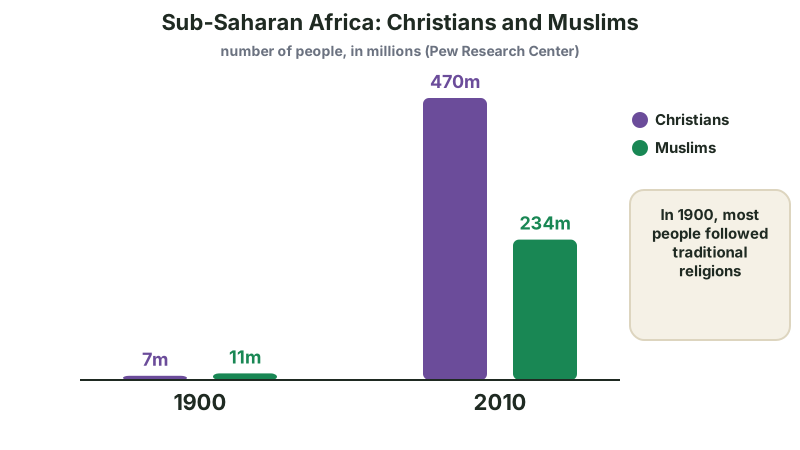
In 1900, there were only about 7 million Christians and 11 million Muslims in sub-Saharan Africa; most people followed traditional religions. By 2010, there were about 470 million Christians and 234 million Muslims, according to the Pew Research Center. Much of this growth happened in the second half of the 20th century, after most countries became independent, when churches and mosques were increasingly led by Africans.
REAL-LIFE CASE STUDY SUDAN AND SOUTH SUDAN, A SHORT HISTORY OF FAITH
The land along the Nile that is now Sudan and South Sudan shows the whole story in one place. In the north, the Christian kingdoms of Nubia lasted for centuries until Islam gradually became the main religion of northern Sudan. In the south, most people followed traditional religions, such as those of the Dinka and Nuer, well into the 20th century. Christian missions arrived in the colonial period but at first won relatively few converts. After independence, Sudan's governments in Khartoum pushed Islamic law and Arabic culture across the country, especially after the 1983 "September Laws" introduced sharia nationally. Many southerners resisted, and during the long civil wars, Christianity grew rapidly in the south. Today, South Sudan is a mainly Christian country where traditional beliefs and practices remain strong.
PRACTICE
Complete the sentences.
Drag a word into each gap, or tap a word and then tap the gap.
- In the AD 330s, King Ezana made Christianity the religion of .
- The Christian kingdoms along the Nile in today's Sudan were called the kingdoms of .
- In West Africa, Islam spread mainly with crossing the Sahara.
- Mansa Musa, who made a famous pilgrimage to Mecca, ruled the empire of .
- The coastal culture of East Africa shaped by Indian Ocean trade is called .
✓ Check Your Understanding
Pick one answer for each question. You'll see the explanation straight away.
1. When did Christianity first become established in Ethiopia?
2. How did Islam mainly spread in West Africa, in places like Mali?
3. What happened around AD 615 that links early Islam with Africa?
4. Roughly how many Christians lived in sub-Saharan Africa in 1900, according to Pew?
5. What were the 1983 "September Laws" in Sudan?
You got out of 5. Excellent work! Read the explanations above, then try again.
Create a free account to tick off lessons and keep track of your progress.