← Back to Religion and Culture in Africa
African Traditional Religions: God, Spirits and Ancestors
Your browser can't read text aloud. Try Chrome, Edge or Safari to hear the words.
WHY THIS MATTERS
Long before Christianity or Islam reached most of Africa, African peoples had rich religious traditions of their own. They explained where the world came from, how to live well, how to heal the sick and how to stay connected to family members who had died. These traditions were often dismissed by outsiders as "pagan" or "primitive". In fact, they are complex systems of belief that still shape how hundreds of millions of Africans think about life, death, family and community.
KEY WORDS
- Supreme Being: the one great God or creator found in most African traditions.
- Divinities: spirits or lesser gods who look after particular things, such as rain, rivers, a clan or a family.
- Ancestors: family members who have died but are believed to remain part of the family and to watch over the living.
- Diviner: a religious specialist who seeks guidance from the spirit world, to find the cause of problems and how to solve them.
- Oral tradition: knowledge passed down by speaking, through stories, songs, proverbs and rituals, rather than written in books.
THERE ARE MANY TRADITIONS NOT JUST ONE
Africa has thousands of ethnic groups, and each has its own religious tradition. Scholars talk about "African traditional religions" (plural) because they differ from place to place. Unlike Christianity and Islam, they usually have no single founder and no single holy book. But many share common features.
COMMON FEATURE 1 ONE SUPREME GOD
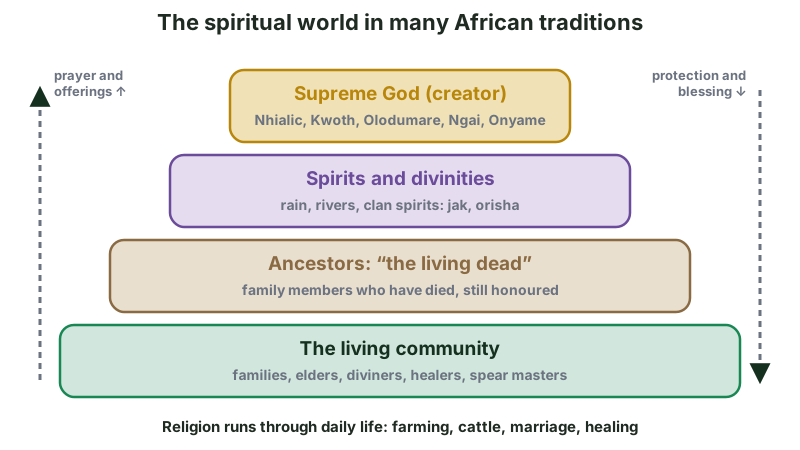
Most African traditions believe in one Supreme Being who created the world. People often see this God as great and far away, approached through spirits and ancestors rather than directly. Some examples:
- Nhialic among the Dinka of South Sudan
- Kwoth among the Nuer of South Sudan
- Olodumare among the Yoruba of Nigeria
- Ngai among the Kikuyu of Kenya, traditionally associated with Mount Kenya
- Onyame among the Akan of Ghana
- uNkulunkulu among the Zulu of South Africa
COMMON FEATURE 2 SPIRITS AND DIVINITIES
Between God and people are many spirits. Among the Dinka, these are called jak; among the Yoruba, the orisha. Some are linked to forces of nature such as rain, thunder or rivers. Others protect a clan, a place or a family.
COMMON FEATURE 3 THE ANCESTORS
In many African cultures, death does not end a person's place in the family. The Kenyan scholar John Mbiti called the recently dead "the living dead", because they are remembered by name and still thought to be present. Families honour ancestors by pouring drinks or offering food, and ask for their protection and blessing. Ancestors who are respected are believed to protect the family; those who are forgotten may cause trouble.
COMMON FEATURE 4 RELIGION IS PART OF EVERYDAY LIFE
In many African languages there is no separate word for "religion", because faith isn't kept to one day a week or one building. It is part of farming, cattle keeping, marriage, naming a baby, healing and leadership. John Mbiti famously wrote that "Africans are notoriously religious", meaning that religion runs through every part of life.
COMMON FEATURE 5 RELIGIOUS SPECIALISTS
Communities have people with special religious roles:
- Diviners, who seek guidance from the spirit world.
- Traditional healers, who use herbs and rituals to treat illness.
- Rain-makers and priests of particular divinities.
- Among the Dinka, "masters of the fishing spear" (bany bith), hereditary spiritual leaders who pray for the community, help settle disputes and lead sacrifices.
COMMON MISUNDERSTANDINGS
- "They had no idea of God." False. Most traditions believe in one Supreme Being.
- "It's all witchcraft." False. Most traditions see harmful witchcraft as evil and something to be protected against.
- "Ancestor veneration is worshipping the dead instead of God." Many believers see it more like showing respect to elders who are still part of the family, while God remains supreme.
REAL-LIFE CASE STUDY AN OX FOR A WEDDING
Among the Dinka, cattle are at the centre of life, both economically and spiritually. When a marriage is agreed, cattle are given by the groom's family to the bride's family, linking the two families together. On important occasions, such as a serious illness or a time of danger, a family may dedicate or sacrifice an ox, praying to Nhialic and the jak for help. The meat is then shared, so the ritual also brings the community together. Today many Dinka are Christians, yet cattle and their meaning remain central to marriage and family life, a sign of how old and new traditions sit side by side.
PRACTICE
Complete the sentences.
Drag a word into each gap, or tap a word and then tap the gap.
- The Dinka name for the Supreme God is .
- Family members who have died but are still honoured are called .
- A specialist who seeks guidance from the spirit world is a .
- Knowledge passed down by speaking, not writing, is called tradition.
- The Yoruba divinities are called the .
✓ Check Your Understanding
Pick one answer for each question. You'll see the explanation straight away.
1. Which statement about African traditional religions is most accurate?
2. Who did John Mbiti call "the living dead"?
3. Kwoth is the name for the Supreme God among which people?
4. Why do many African languages have no separate word for "religion"?
5. Among the Dinka, who are the "masters of the fishing spear"?
You got out of 5. Excellent work! Read the explanations above, then try again.
Create a free account to tick off lessons and keep track of your progress.