← Back to Practical Maths for Everyday Life
Celsius, Fahrenheit and Everyday Time Calculations
Your browser can't read text aloud. Try Chrome, Edge or Safari to hear the words.
WHY THIS MATTERS
Weather apps, oven dials, thermometers and recipes may use Celsius or Fahrenheit depending on where they come from. And questions like "how many weeks are in a year?" are among the most searched maths questions on the internet. Knowing how to work them out means you never have to look them up again.
KEY WORDS
- Celsius (°C): water freezes at 0 °C and boils at 100 °C. Used in most countries.
- Fahrenheit (°F): water freezes at 32 °F and boils at 212 °F. Used mainly in the United States.
- Leap year: a year with 366 days instead of 365. February gets an extra day, the 29th.
CELSIUS TO FAHRENHEIT
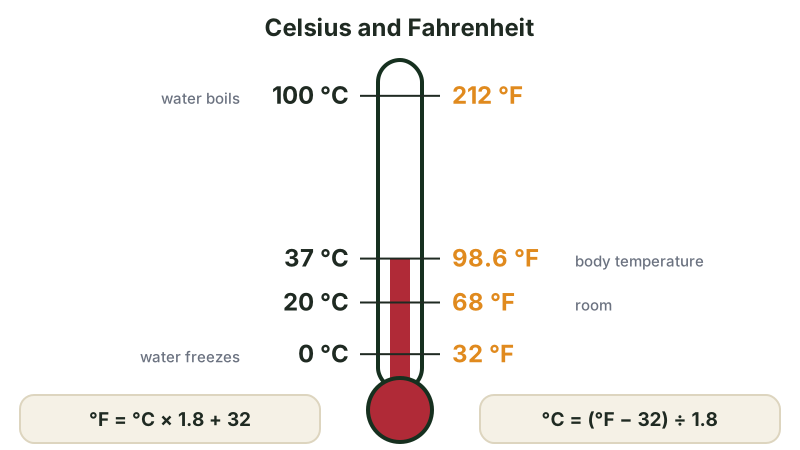
Formula: °F = (°C × 9 ÷ 5) + 32
You can use 1.8 instead of 9 ÷ 5.
Example: 25 °C → 25 × 1.8 = 45, then 45 + 32 = 77 °F.
FAHRENHEIT TO CELSIUS
Formula: °C = (°F − 32) × 5 ÷ 9
Example: 86 °F → 86 − 32 = 54, then 54 × 5 ÷ 9 = 30 °C.
Order matters: always subtract 32 first.
QUICK ESTIMATE DOUBLE AND ADD 30
- Celsius to Fahrenheit: double it, then add 30. 20 °C → 40 + 30 = 70 °F (exact: 68 °F).
- Fahrenheit to Celsius: take away 30, then halve it. 80 °F → 50 ÷ 2 = 25 °C (exact: 26.7 °C).
This is close for everyday weather, but not accurate enough for cooking or a fever.
TEMPERATURES WORTH KNOWING
- 0 °C = 32 °F: water freezes
- 20 °C = 68 °F: a comfortable room
- 30 °C = 86 °F: a hot day
- 37 °C = 98.6 °F: normal body temperature
- 38 °C = 100.4 °F: a fever, generally
- 100 °C = 212 °F: water boils
- 180 °C = 356 °F: a moderate oven (recipes usually round this to 350 °F)
- −40 °C = −40 °F: the one temperature where both scales match
TIME FACTS PEOPLE SEARCH FOR
- 60 seconds = 1 minute, and 60 minutes = 1 hour
- 1 day = 24 hours = 1,440 minutes = 86,400 seconds
- 1 week = 7 days = 168 hours
- 1 year = 365 days (366 in a leap year)
- Weeks in a year: 365 ÷ 7 = 52 weeks and 1 day (52 weeks and 2 days in a leap year)
- Weeks in a month: on average 52 ÷ 12, which is about 4.3 weeks. A month is never exactly 4 weeks, except February in a normal year.
- Hours in a year: 365 × 24 = 8,760
- Seconds in a year: 365 × 86,400 = 31,536,000
LEAP YEARS
A year is a leap year if it can be divided by 4, for example 2024 and 2028. The exception: years ending in 00 are only leap years if they can be divided by 400. So 2000 was a leap year, but 1900 was not.
USING THIS AT WORK WEEKLY, FORTNIGHTLY AND MONTHLY PAY
- Weekly to yearly: multiply by 52.
- Fortnightly to yearly: multiply by 26.
- Monthly to yearly: multiply by 12.
- Yearly to weekly: divide by 52.
Example: a rent of $400 a week is 400 × 52 = $20,800 a year. Divided by 12, that's about $1,733 a month, not $1,600. Using "4 weeks in a month" makes monthly costs look lower than they really are.
REAL-LIFE CASE STUDY MARIA CHECKS HER CHILD'S TEMPERATURE
Maria's thermometer was bought in the United States and shows 101.3 °F. Her doctor's advice sheet says to call if a child's temperature is above 38.5 °C.
- 101.3 − 32 = 69.3
- 69.3 × 5 ÷ 9 = 38.5 °C
Her child's temperature is right at the level on the sheet, so she calls the doctor for advice. The quick "take away 30 and halve" estimate gives 35.7 °C, which would have been badly wrong here. For health and cooking, always use the exact formula.
PRACTICE
Complete the sentences.
Drag a word into each gap, or tap a word and then tap the gap.
- Water freezes at 0 °C, which is °F.
- Water boils at 100 °C, which is °F.
- One day has hours.
- A normal year has 52 weeks and day.
- A leap year has days.
✓ Check Your Understanding
Pick one answer for each question. You'll see the explanation straight away.
1. The weather forecast says 35 °C. What is that in Fahrenheit?
2. An American recipe says to bake at 400 °F. What is that in Celsius, roughly?
3. How many weeks are in a normal (non-leap) year?
4. How many seconds are in one day?
5. Your rent is $350 a week. What is it per month on average?
You got out of 5. Excellent work! Read the explanations above, then try again.
Create a free account to tick off lessons and keep track of your progress.