← Back to Practical Maths for Everyday Life
Metric and Imperial: Height, Weight and Distance
Your browser can't read text aloud. Try Chrome, Edge or Safari to hear the words.
WHY THIS MATTERS
Most of the world uses the metric system (metres, kilograms), but the United States uses imperial units (feet, pounds, miles), and the UK uses a mix: road signs in miles, body weight often in stones. Online shopping, travel, job forms, medical forms and sports all make you switch between the two.
KEY WORDS
- Metric system: millimetres (mm), centimetres (cm), metres (m), kilometres (km), grams (g) and kilograms (kg). Every step is a multiple of 10.
- Imperial system: inches (in), feet (ft), yards (yd), miles (mi), ounces (oz), pounds (lb) and stones (st).
- Conversion factor: the number you multiply or divide by to change units.
METRIC STEPS JUST MOVE THE DECIMAL POINT
- 10 mm = 1 cm
- 100 cm = 1 m
- 1,000 m = 1 km
- 1,000 g = 1 kg
Example: 2.5 m = 250 cm. And 750 g = 0.75 kg.
THE KEY CONVERSION FACTORS
Length and height:
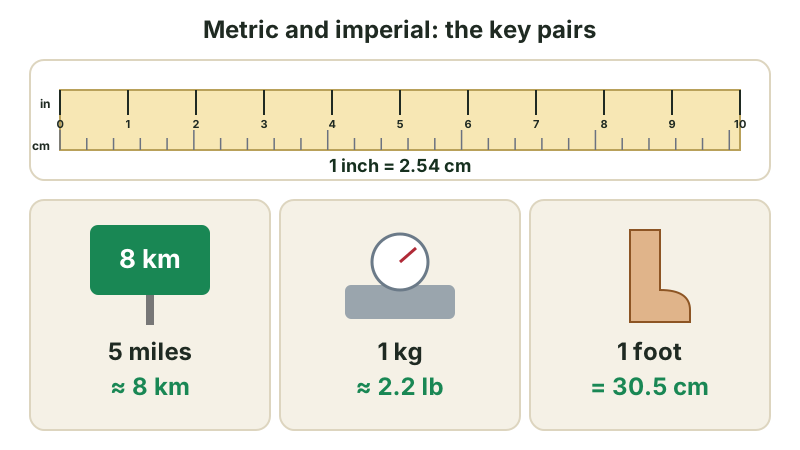
- 1 inch = 2.54 cm (exactly)
- 1 foot = 12 inches = 30.48 cm
- 1 metre = about 3.28 feet, or 39.4 inches
- 1 yard = 3 feet = 0.91 m
Distance:
- 1 mile = 1.609 km
- 1 km = 0.621 miles
Weight:
- 1 kg = 2.205 lb
- 1 lb = 0.454 kg
- 1 stone = 14 lb = 6.35 kg
WHICH WAY DO I MULTIPLY OR DIVIDE
A simple check: when you change to a smaller unit, you get a bigger number. Centimetres are smaller than inches, so inches to centimetres means the number gets bigger: multiply by 2.54. Centimetres to inches means the number gets smaller: divide by 2.54.
QUICK MENTAL ESTIMATES
- Kilograms to pounds: double it and add 10%. 70 kg → 140 + 14 = 154 lb (exact: 154.3 lb).
- Pounds to kilograms: halve it and take off 10%. 200 lb → 100 − 10 = 90 kg (exact: 90.7 kg).
- Miles to kilometres: multiply by 1.6. 50 miles → 80 km.
- Kilometres to miles: multiply by 0.6. 100 km → 60 miles (exact: 62.1 miles).
- Handy pairs to remember: 5 miles ≈ 8 km, and 8 miles ≈ 13 km.
HEIGHT FEET AND INCHES TO CENTIMETRES
- Turn everything into inches: feet × 12, plus the extra inches.
- Multiply by 2.54.
Example: 5 feet 10 inches = (5 × 12) + 10 = 70 inches. Then 70 × 2.54 = 177.8 cm, so about 178 cm.
Going back: 165 cm ÷ 2.54 = 65 inches. Then 65 ÷ 12 = 5 remainder 5, so 5 feet 5 inches.
SPEED
- 100 km/h = about 62 mph
- 60 mph = about 97 km/h
- Speed conversions use the same factors as distance: multiply mph by 1.609 to get km/h.
THE CONVERSION-FACTOR METHOD (FOR TRICKY CHAINS)
Write each conversion as a fraction that equals 1, then multiply. Units on the top and bottom cancel out, so you can check you haven't flipped anything.
Example: how many centimetres in 3 yards?
- 3 yards × (3 feet ÷ 1 yard) = 9 feet
- 9 feet × (12 inches ÷ 1 foot) = 108 inches
- 108 inches × (2.54 cm ÷ 1 inch) = 274.32 cm
REAL-LIFE CASE STUDY DAVID FILLS IN A VISA MEDICAL FORM
The form asks for height in centimetres and weight in kilograms. David knows he is 6 feet 1 inch and 185 lb.
- Height: (6 × 12) + 1 = 73 inches. Then 73 × 2.54 = 185.4 cm, so he writes 185 cm.
- Weight: 185 × 0.454 = 84 kg (exact: 83.9 kg).
Funny coincidence: his height in centimetres and his weight in pounds are both about 185.
PRACTICE
Complete the sentences.
Drag a word into each gap, or tap a word and then tap the gap.
- One foot is inches.
- One inch is cm.
- One stone is pounds.
- A distance of 50 miles is about km.
- One metre is cm.
✓ Check Your Understanding
Pick one answer for each question. You'll see the explanation straight away.
1. Someone is 5 feet 8 inches tall. What is that in centimetres, to the nearest whole number?
2. A suitcase limit is 23 kg. Roughly what is that in pounds?
3. A road sign in the UK says 30 miles. About how far is that in kilometres?
4. A TV screen is 55 inches across. How many centimetres is that?
5. A friend says they weigh 11 stone. How much is that in kilograms?
You got out of 5. Excellent work! Read the explanations above, then try again.
Create a free account to tick off lessons and keep track of your progress.