← Back to Practical Maths for Everyday Life
Cooking Conversions: Cups, Tablespoons, Grams and Ounces
Your browser can't read text aloud. Try Chrome, Edge or Safari to hear the words.
WHY THIS MATTERS
Recipes online come from all over the world. An American recipe says "1 cup of flour" and "2 sticks of butter", a British one says "200 g", and an Australian one uses a different-sized tablespoon. Getting conversions wrong is the main reason a cake sinks or a sauce is too salty. Once you know a few key numbers, you can cook from any recipe.
KEY WORDS
- Volume: how much space something takes up. Measured in millilitres (mL), litres (L), cups, tablespoons (tbsp) and teaspoons (tsp).
- Weight (mass): how heavy something is. Measured in grams (g), kilograms (kg), ounces (oz) and pounds (lb).
- Fluid ounce (fl oz): a measure of volume, not weight.
- Ounce (oz): a measure of weight. A fluid ounce and an ounce are different things.
THE NUMBERS TO REMEMBER
- 1 teaspoon (tsp) = 5 mL
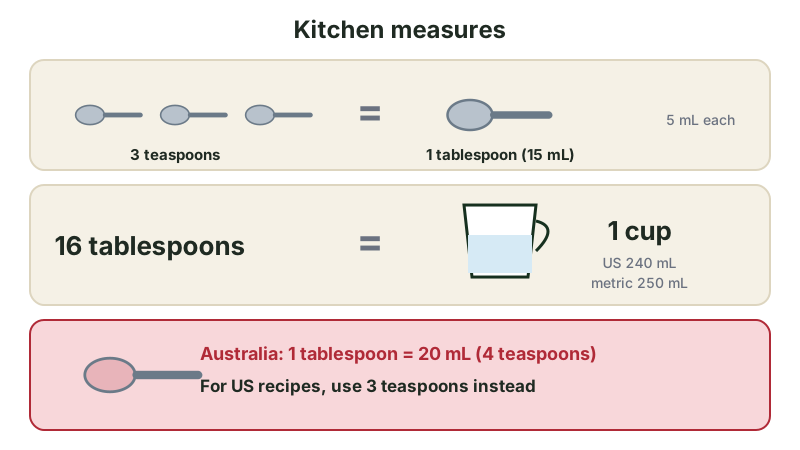
- 1 tablespoon (tbsp) = 15 mL, which is 3 teaspoons
- 1 cup = 16 tablespoons
- 1/2 cup = 8 tablespoons
- 1/4 cup = 4 tablespoons
- 1 US cup = about 240 mL (237 mL exactly)
- 1 metric cup = 250 mL (used in Australia, New Zealand and Canada)
- 1 US fluid ounce = about 30 mL (29.6 mL exactly)
- 8 fluid ounces = 1 US cup
WATCH OUT THE AUSTRALIAN TABLESPOON
In Australia, a tablespoon is 20 mL (4 teaspoons), not 15 mL. If you use an Australian tablespoon for an American recipe, you add a third more than intended. That matters for salt, baking powder and baking soda. For small amounts of strong ingredients, measure in teaspoons to be safe: 1 US tablespoon = 3 teaspoons.
AMERICAN LIQUID MEASURES
- 2 cups = 1 pint
- 2 pints = 1 quart
- 4 quarts = 1 gallon
- 16 cups = 1 gallon
- 128 fluid ounces = 1 US gallon
- 1 US gallon = about 3.8 litres
CUPS TO GRAMS IT DEPENDS WHAT'S IN THE CUP
A cup measures volume, but different foods weigh different amounts. A cup of flour is much lighter than a cup of sugar. These are typical weights for one US cup:
- Water or milk: about 240 g
- Plain (all-purpose) flour: about 125 g
- White sugar: about 200 g
- Brown sugar, packed: about 220 g
- Uncooked rice: about 185 g
- Butter: about 227 g (1 cup = 2 American "sticks", and 1 stick = 113 g)
Flour weights vary depending on how tightly the cup is filled, so for baking, weighing is more accurate than cups.
OUNCES AND POUNDS TO GRAMS
- 1 ounce (oz) = 28.35 g, so roughly 28 g or "about 30 g" for quick estimates
- 1 pound (lb) = 16 ounces = 454 g
- 1 kg = 2.2 lb
- Example: a recipe asks for 12 oz of chicken. 12 × 28.35 = 340 g.
SCALING A RECIPE UP OR DOWN
To change the number of servings, find the scale factor: new servings ÷ original servings. Multiply every ingredient by it.
- A recipe serves 4 and you need to feed 6. Scale factor: 6 ÷ 4 = 1.5.
- 2 cups of rice becomes 2 × 1.5 = 3 cups.
- 3 tablespoons of oil becomes 3 × 1.5 = 4.5 tablespoons.
Cooking times usually change less than the ingredients do, so check food is cooked rather than multiplying the time.
REAL-LIFE CASE STUDY GRACE BAKES AN AMERICAN BANANA BREAD IN SYDNEY
The recipe says: 2 cups flour, 3/4 cup sugar, 1 stick butter, 1 tsp baking soda, 1/2 tsp salt.
Grace has kitchen scales and Australian spoons.
- Flour: 2 × 125 g = 250 g
- Sugar: 3/4 × 200 g = 150 g
- Butter: 1 stick = 113 g
- Baking soda: 1 teaspoon is 5 mL everywhere, so her teaspoon is fine.
- Salt: 1/2 teaspoon, also fine.
Because the recipe uses teaspoons, not tablespoons, her Australian spoons cause no problem. If it had said 1 tablespoon of baking soda, she would use 3 teaspoons instead of her 20 mL tablespoon.
PRACTICE
Complete the sentences.
Drag a word into each gap, or tap a word and then tap the gap.
- One tablespoon is the same as teaspoons in a US recipe.
- A quarter cup is tablespoons.
- One US gallon holds fluid ounces.
- One pound is ounces.
- In Australia, a tablespoon holds mL.
✓ Check Your Understanding
Pick one answer for each question. You'll see the explanation straight away.
1. How many tablespoons are in 1/4 cup?
2. How many grams are in one ounce?
3. A recipe needs 2 cups of plain flour. Roughly how many grams is that?
4. An American recipe uses 1 tablespoon of salt. You only have an Australian tablespoon. What should you use?
5. A soup recipe serves 4 and uses 6 cups of stock. How much stock do you need to serve 10 people?
You got out of 5. Excellent work! Read the explanations above, then try again.
Create a free account to tick off lessons and keep track of your progress.