← Back to Practical Maths for Everyday Life
Travel Time, Speed and Distance
Your browser can't read text aloud. Try Chrome, Edge or Safari to hear the words.
WHY THIS MATTERS
Whether you're driving to a job interview, catching a bus to another town or walking to school, the same simple formula tells you how long it will take. Knowing it helps you plan, avoid being late, and check whether a map app's estimate makes sense.
KEY WORDS
- Distance: how far you travel, for example in kilometres (km) or miles.
- Speed: how far you travel in one hour, for example kilometres per hour (km/h).
- Time: how long the trip takes.
- Average speed: your overall speed for the whole trip, including slow parts, traffic and stops.
THE THREE FORMULAS
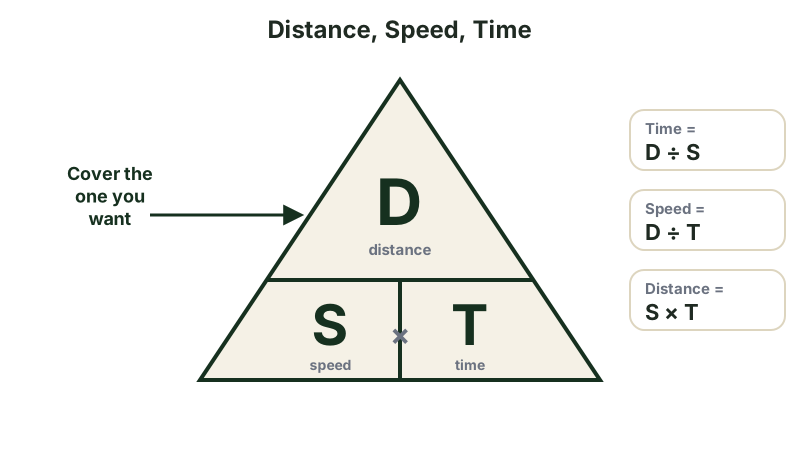
- Distance = Speed × Time
- Time = Distance ÷ Speed
- Speed = Distance ÷ Time
Memory trick: draw a triangle with D at the top, and S and T at the bottom. Cover the one you want to find. If D is on top of S, divide. If S and T sit side by side, multiply.
Important: the units must match. If distance is in km and speed is in km/h, the time comes out in hours.
TURNING HOURS INTO HOURS AND MINUTES
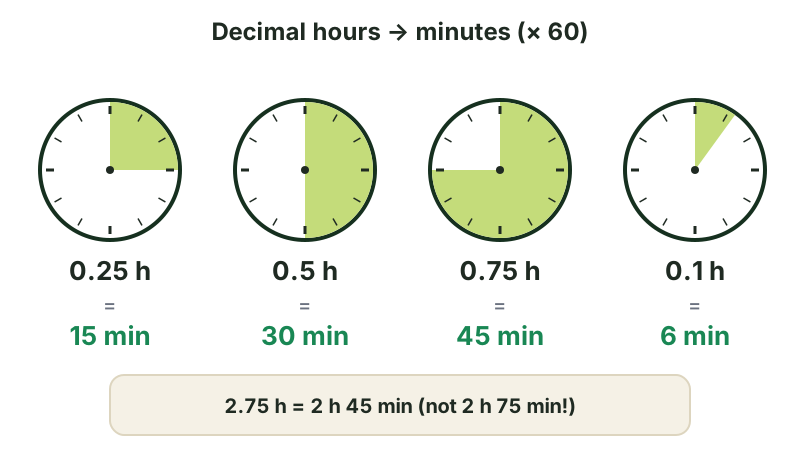
Calculators give time as a decimal, like 2.75 hours. That does not mean 2 hours and 75 minutes.
- Keep the whole number: 2 hours.
- Multiply the decimal part by 60: 0.75 × 60 = 45 minutes.
- So 2.75 hours = 2 hours 45 minutes.
Useful ones to remember:
- 0.25 hours = 15 minutes
- 0.5 hours = 30 minutes
- 0.75 hours = 45 minutes
- 0.1 hours = 6 minutes
Going the other way, divide minutes by 60 to get hours: 45 minutes = 45 ÷ 60 = 0.75 hours.
EXAMPLE 1 HOW LONG WILL IT TAKE?
A town is 240 km away and you expect to average 80 km/h.
Time = 240 ÷ 80 = 3 hours.
EXAMPLE 2 HOW FAST WERE YOU GOING?
A bus travels 50 km in 1 hour 15 minutes. First change the time into hours: 1 hour 15 minutes = 1.25 hours.
Speed = 50 ÷ 1.25 = 40 km/h.
EXAMPLE 3 HOW FAR CAN YOU WALK?
Most adults walk at about 5 km/h. In 36 minutes (0.6 hours) you can walk about 5 × 0.6 = 3 km.
WHAT TIME SHOULD I LEAVE
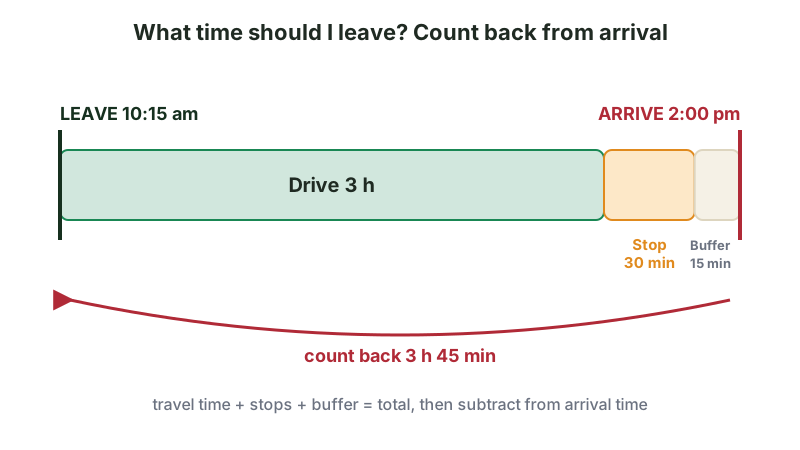
- Work out the travel time.
- Add time for stops (fuel, food, rest breaks).
- Add a safety buffer for traffic or delays, often 10 to 20 minutes.
- Count back from the time you need to arrive.
Example: you need to arrive at 2:00 pm. The drive takes 3 hours, you plan one 30-minute rest stop, and you add a 15-minute buffer. Total: 3 hours 45 minutes. Counting back from 2:00 pm, leave by 10:15 am.
TRAP AVERAGE SPEED IS NOT THE SPEED LIMIT
On a 100 km/h highway, your average speed is usually lower because of towns, roadworks, traffic and stops. In busy city traffic, 25 to 40 km/h is common. Use a realistic average, not the speed limit.
TRAP YOU CAN'T JUST AVERAGE TWO SPEEDS
You drive 60 km to a market at 60 km/h, and come back at 40 km/h because of traffic. Your average speed is not 50 km/h.
- Going: 60 ÷ 60 = 1 hour
- Coming back: 60 ÷ 40 = 1.5 hours
- Total: 120 km in 2.5 hours, so 120 ÷ 2.5 = 48 km/h
You spend longer at the slower speed, so it pulls the average down.
REAL-LIFE CASE STUDY JOSEPH'S DELIVERY RUN
Joseph delivers goods to three villages in one day.
- Leg 1: 36 km on a good road at 60 km/h → 36 ÷ 60 = 0.6 hours = 36 minutes
- Leg 2: 20 km on a rough road at 25 km/h → 20 ÷ 25 = 0.8 hours = 48 minutes
- Leg 3: 44 km back on a tar road at 80 km/h → 44 ÷ 80 = 0.55 hours = 33 minutes
Driving time: 36 + 48 + 33 = 117 minutes = 1 hour 57 minutes. With 20 minutes unloading at each of the three stops, the whole run takes about 2 hours 57 minutes. If he leaves at 8:00 am, he'll be back just before 11:00 am, in time to take an afternoon booking.
PRACTICE
Complete the sentences.
Drag a word into each gap, or tap a word and then tap the gap.
- Travelling 150 km at 50 km per hour takes hours.
- Half an hour is minutes.
- A time of 1.25 hours is 1 hour and minutes.
- Covering 120 km in 2 hours is an average speed of km per hour.
- Walking at 5 km per hour for 2 hours covers km.
✓ Check Your Understanding
Pick one answer for each question. You'll see the explanation straight away.
1. A town is 210 km away. If you average 70 km/h, how long will the trip take?
2. Your map app says the trip will take 2.4 hours. How long is that in hours and minutes?
3. Your job interview is at 9:00 am, 45 km away. In morning traffic you'll average 30 km/h, and you want to arrive 15 minutes early. What is the latest time you should leave?
4. A bus travels 18 km in 36 minutes. What is its average speed?
5. You drive 100 km to town at 100 km/h and return the same way at 50 km/h. What is your average speed for the whole trip?
You got out of 5. Excellent work! Read the explanations above, then try again.
Create a free account to tick off lessons and keep track of your progress.