← Back to Practical Maths for Everyday Life
How to Calculate Discounts and Sale Prices
Your browser can't read text aloud. Try Chrome, Edge or Safari to hear the words.
WHY THIS MATTERS
Shops know that most people don't stop to check the maths. "Up to 50% off", "buy 2 get 1 free" and "extra 20% off at checkout" are designed to feel like big savings. In a few seconds you can work out what you will actually pay, and which deal really is cheaper.
KEY WORDS
- Original price: the normal price before the sale (sometimes called the RRP, or recommended retail price).
- Discount: the amount taken off the price.
- Percentage (%): "out of 100". 25% means 25 out of every 100.
- Sale price: what you actually pay after the discount.
- Unit price: the price for one unit, such as per kilogram, per litre or per item.
METHOD 1 FIND THE DISCOUNT, THEN SUBTRACT
- Turn the percentage into a decimal by dividing by 100. For example, 25% becomes 0.25.
- Multiply the original price by that decimal. This is your saving.
- Subtract the saving from the original price.
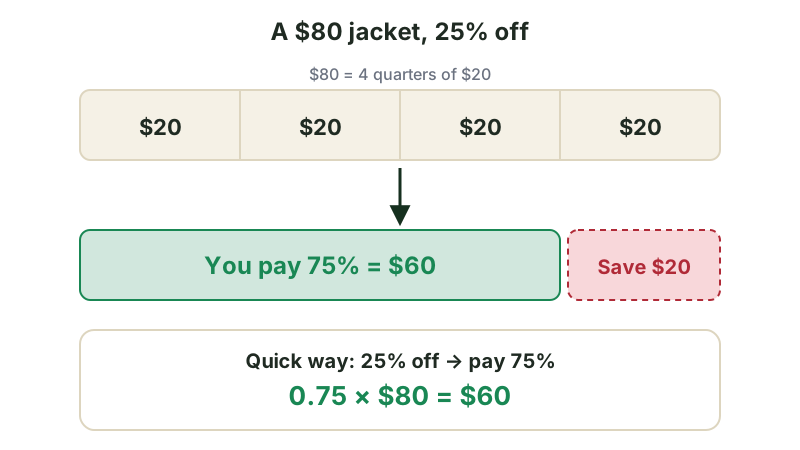
Example: a jacket costs $80 and is 25% off.
- Saving: 0.25 × $80 = $20
- Sale price: $80 − $20 = $60
METHOD 2 THE ONE-STEP SHORTCUT
If something is 25% off, you pay the other 75%. So multiply by what you pay:
- 0.75 × $80 = $60
This is faster, and it's the method that works best on a phone calculator.
- 10% off → multiply by 0.9
- 20% off → multiply by 0.8
- 30% off → multiply by 0.7
- 15% off → multiply by 0.85
MENTAL MATHS TRICKS no calculator needed
- 10%: move the decimal point one place left. 10% of $64 = $6.40
- 5%: half of 10%. 5% of $64 = $3.20
- 20%: double 10%. 20% of $64 = $12.80
- 25%: divide by 4. 25% of $64 = $16
- 50%: halve it. 50% of $64 = $32
- 15%: 10% plus 5%. 15% of $64 = $6.40 + $3.20 = $9.60
Example: a pair of shoes costs $240 with 15% off. 10% is $24 and 5% is $12, so the discount is $36. You pay $240 − $36 = $204.
WORKING BACKWARDS
What percentage off is it? Divide the saving by the original price, then multiply by 100.
- A $120 kettle is on sale for $90. The saving is $30. 30 ÷ 120 = 0.25, so it's 25% off.
What was the original price? Divide the sale price by the part you paid.
- You paid $63 after 30% off, so you paid 70% of the price. $63 ÷ 0.7 = $90.
- A common mistake is to add 30% of $63 back on. That gives $81.90, which is wrong, because the 30% was taken from the original price, not from $63.
TRAP 1 STACKED DISCOUNTS DON'T ADD UP
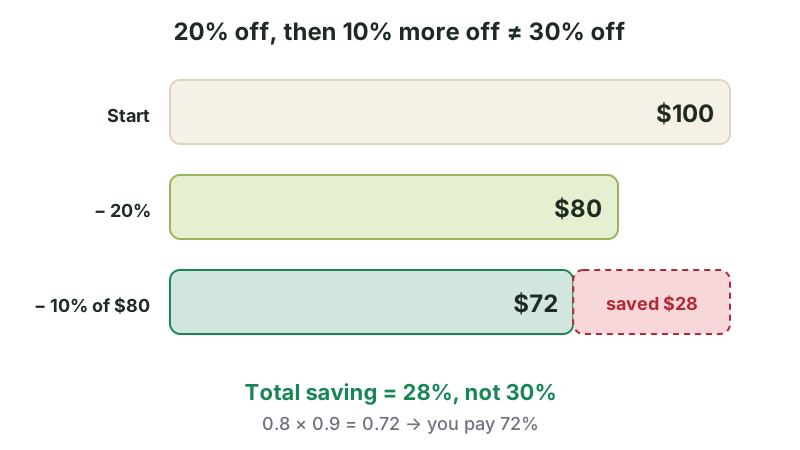
"20% off, plus an extra 10% off at the checkout" is not 30% off. The second discount comes off the already-reduced price.
- Start with $100. After 20% off: $100 × 0.8 = $80.
- After another 10% off: $80 × 0.9 = $72.
- Total saving: $28, which is 28%, not 30%.
Quick method: multiply the parts you pay. 0.8 × 0.9 = 0.72, so you pay 72%.
TRAP 2 "BUY 2, GET 1 FREE" VS "30% OFF"
Buy 2, get 1 free means you get 3 items for the price of 2. You pay 2 ÷ 3 = 0.667, or about 66.7% of the normal price, which is a 33.3% discount on each item. That beats 30% off, but only if you actually need 3.
TRAP 3 THE BIGGER PACK ISN'T ALWAYS CHEAPER
Always compare the unit price.
- Shampoo A: 400 mL for $6.00. Per 100 mL: $6.00 ÷ 4 = $1.50
- Shampoo B: 750 mL for $10.50. Per 100 mL: $10.50 ÷ 7.5 = $1.40
Shampoo B is cheaper per 100 mL. Many supermarkets print the unit price in small type on the shelf label. Look for it.
TRAP 4 THE INFLATED "WAS" PRICE
Some sellers raise the "was" price just before a sale so the discount looks bigger. "Was $99, now $59" means nothing if it normally sold for $65. Before a big purchase, check the price at two or three other shops or online.
REAL-LIFE CASE STUDY AMINA BUYS A FRIDGE
Amina sees the same fridge in two shops.
- Shop A: $1,200 with 25% off.
- Shop B: $1,100 with 15% off, plus free delivery (Shop A charges $60 delivery).
Shop A: $1,200 × 0.75 = $900, plus $60 delivery = $960.
Shop B: $1,100 × 0.85 = $935, with free delivery = $935.
The bigger percentage looked better, but Shop B saves Amina $25. Lesson: compare the final price you will pay, including extras, not the percentage.
PRACTICE
Complete the sentences.
Drag a word into each gap, or tap a word and then tap the gap.
- 10% of $70 is .
- A $50 shirt with 20% off costs .
- If something is 25% off, you pay of the price.
- Going from $200 down to $150 is a discount.
- Taking 20% off and then a further 10% off saves in total.
✓ Check Your Understanding
Pick one answer for each question. You'll see the explanation straight away.
1. A television costs $650 and is 20% off. What is the sale price?
2. Which is the better deal for the same pair of jeans?
3. A shop offers 30% off, then an extra 20% off at the checkout. What is the total discount?
4. You paid $36 for a toaster after a 25% discount. What was the original price?
5. Rice comes in a 5 kg bag for $9.50 or a 2 kg bag for $4.20. Which is cheaper per kilogram?
You got out of 5. Excellent work! Read the explanations above, then try again.
Create a free account to tick off lessons and keep track of your progress.