← Back to Economics and Money Made Simple
How to Make a Budget: The 50/30/20 Rule
Your browser can't read text aloud. Try Chrome, Edge or Safari to hear the words.
WHY THIS MATTERS
Many people get to the end of the month and wonder where their money went. A budget is simply a plan for your money. It helps you pay for what you need, avoid debt, and save for emergencies and goals like school fees, a business or a house. "How to make a budget" is one of the most common money questions people search for, and the 50/30/20 rule is one of the easiest places to start.
KEY WORDS
- Budget: a plan for how you will spend and save your income.
- Needs: things you must pay for to live and work, such as rent, food, transport, school fees and bills.
- Wants: things that are nice to have but not essential, such as eating out, new clothes beyond what you need, or entertainment.
- Emergency fund: savings kept aside for unexpected costs, such as illness or job loss.
- Net income: your pay after tax and other deductions, the amount you actually receive.
THE 50/30/20 RULE
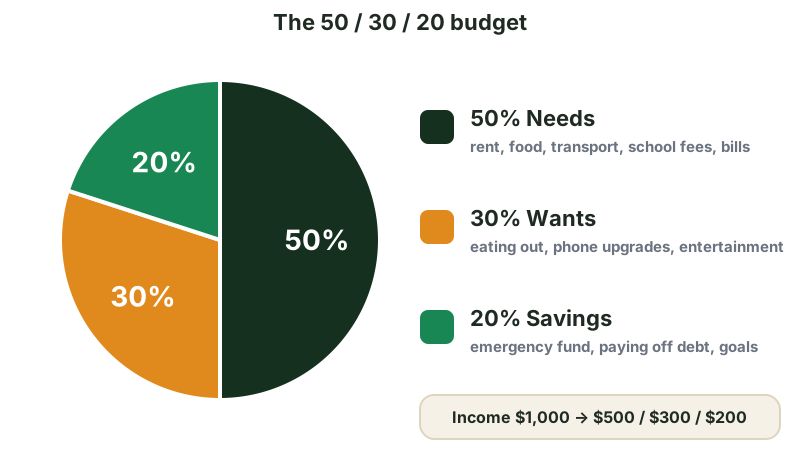
Split your net income into three parts:
- 50% for needs
- 30% for wants
- 20% for savings and paying off debt
Example: you take home $1,000 a month.
- Needs: $1,000 × 0.5 = $500
- Wants: $1,000 × 0.3 = $300
- Savings and debt: $1,000 × 0.2 = $200
MAKE YOUR OWN BUDGET IN 5 STEPS
- Write down your monthly net income. If your income changes, use a low, typical month.
- List all your needs and their costs.
- List your wants and what you usually spend on them.
- Decide how much you'll save. Treat savings like a bill: put it aside as soon as you're paid.
- Track your spending for a month, then adjust.
WHEN 50/30/20 DOESN'T FIT
For many families, especially on low incomes or where food and rent are expensive, needs take far more than half. That's normal. Adjust the rule to fit your life:
- A common alternative is 70/20/10: 70% needs, 20% savings and debt, 10% wants.
- Even saving 5% or 10% is a great start. The habit matters more than the exact number.
- Look for the biggest costs first. Saving a little on rent or transport often matters more than cutting small treats.
BUILDING AN EMERGENCY FUND
Aim to save enough to cover about 3 months of your needs. If your needs cost $600 a month, that's $600 × 3 = $1,800. It takes time, so start small. An emergency fund stops one bad month, like a hospital bill or a broken phone, from pushing you into expensive debt.
SAVINGS GROUPS
In many communities, people save together in savings groups, such as village savings and loan associations, where members put in a fixed amount each week and can borrow from the group. They are a good way to save regularly and get small loans without high interest, but choose a group you trust and that keeps clear records.
REAL-LIFE CASE STUDY PETER'S FIRST BUDGET
Peter, a bus driver, takes home $2,400 a month. Using 50/30/20 as a guide, he aims for $1,200 on needs, $720 on wants and $480 on savings.
When he tracks his spending, he finds his needs are actually $1,500: rent $900, food $400 and transport $200. He's also spending $800 on wants, mostly takeaway meals and phone credit, and saving only $100.
So he adjusts:
- He cooks at home more and switches to a cheaper phone plan, bringing his wants down from $800 to $500.
- That frees up $300, so he now saves $400 a month instead of $100.
His new budget is about 62% needs, 21% wants and 17% savings. It isn't exactly 50/30/20, but it works for him. Within 4 months he has saved $1,600, enough to cover one month of his needs, the first step towards his emergency fund.
PRACTICE
Complete the sentences.
Drag a word into each gap, or tap a word and then tap the gap.
- In the 50/30/20 rule, half your income goes on .
- Eating out and entertainment are examples of .
- Savings kept for unexpected costs are called an emergency .
- With an income of $1,000, the 20% savings share is $ .
- A good emergency fund covers about months of needs.
✓ Check Your Understanding
Pick one answer for each question. You'll see the explanation straight away.
1. You take home $1,500 a month. Using the 50/30/20 rule, how much should go to savings and debt?
2. Which of these is a need rather than a want?
3. Your needs cost $800 a month. How much should your emergency fund be, using the 3-month guide?
4. Your rent and food already take 70% of your income. What's the best approach?
5. When is the best time to put money into savings?
You got out of 5. Excellent work! Read the explanations above, then try again.
Create a free account to tick off lessons and keep track of your progress.