← Back to Economics and Money Made Simple
Working Class, Middle Class and Upper Class Explained
Your browser can't read text aloud. Try Chrome, Edge or Safari to hear the words.
WHY THIS MATTERS
You'll hear politicians promise to help "the middle class" and news stories about "the working class". But what do these words actually mean? There isn't one official definition. Economists, sociologists and governments measure class in different ways: by income, by type of job, by wealth or by education. Understanding these helps you make sense of the news and of debates about fairness and opportunity.
KEY WORDS
- Social class: a group of people with a similar economic and social position in society.
- Income: money received regularly, such as wages, salary, profits or rent.
- Wealth: the total value of what you own, such as land, houses, savings, livestock and businesses, minus what you owe.
- Wage: pay usually calculated by the hour, day or week, often for manual or service work.
- Salary: a fixed yearly amount paid in regular instalments, often for professional jobs.
- Social mobility: moving between classes, for example a child of farm workers becoming a doctor.
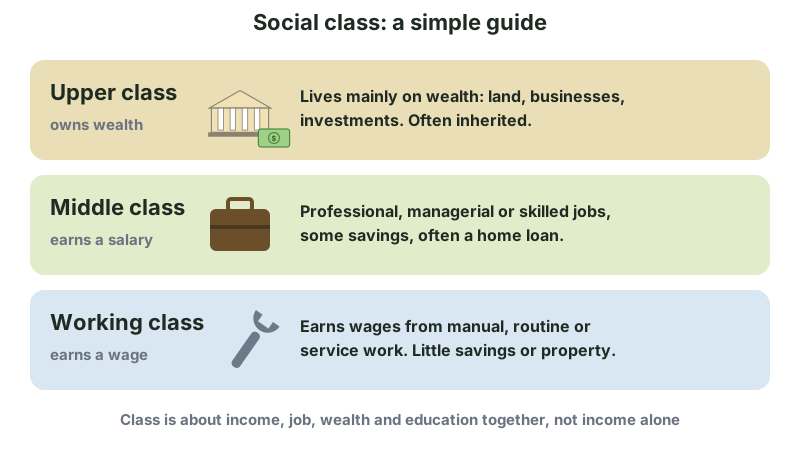
THREE CLASSES THE COMMON DEFINITIONS
Working class: people who earn their living mainly from wages, often in manual, routine or service jobs such as farm work, factory work, construction, cleaning, driving or shop work. They usually have limited savings and own little property, so losing a job can quickly cause hardship.
Middle class: people in professional, managerial, technical or skilled jobs, such as teachers, nurses, engineers, office managers and many small-business owners. They often have a salary, some savings, more education and may own a home with a loan.
Upper class: people whose income comes mainly from wealth rather than work, such as owning land, large businesses, property or investments. Their wealth is often inherited and passed down through families. Very high earners such as top executives are sometimes included.
WAY 1 CLASS BY INCOME
Many researchers group households by income compared with the typical (median) household in their country.
- The Pew Research Center in the United States calls a household "middle income" if it earns between two-thirds and double the national median income, adjusted for household size. By that measure, about half of US households (51%) were middle income in 2023, about 30% lower income and 19% upper income.
- The African Development Bank used a different measure for Africa: people spending between $2 and $20 a day. By that definition, about 34% of Africans, or 313 million people, were middle class in 2010. The bank pointed out that many people at the bottom of that range, spending $2 to $4 a day, could easily fall back into poverty.
This shows why "middle class" means very different things in different countries.
WAY 2 CLASS BY JOB AND WEALTH
Some researchers focus on the type of work people do and whether they own things that produce income:
- The philosopher Karl Marx divided society mainly into those who own businesses, land and factories, and those who sell their labour for wages.
- The sociologist Max Weber argued class also depends on skills and qualifications, and that social status and political power matter too.
- A large British study in 2013, the Great British Class Survey, used income, wealth, social connections and cultural activities and found seven classes, from an "elite" at the top to a "precariat" of people with insecure work and low income at the bottom.
WHY CLASS IS DIFFERENT IN EACH COUNTRY
A teacher in Juba and a teacher in Sydney may both feel middle class, but their incomes are very different. Class depends on how your income and lifestyle compare with others around you, not on a single number for the whole world. In many African countries, people also mix sources of income: a civil servant may also farm, keep cattle and run a small shop, which makes simple labels harder to apply.
SOCIAL MOBILITY
Social mobility means moving up or down between classes, within your life or across generations. Things that often help people move up include education and training, access to loans to start a business, good health, and fair access to jobs. Things that can push people down include job loss, illness, conflict, and high inflation that wipes out savings. How easy it is to move between classes is a big topic of political debate in many countries.
REAL-LIFE CASE STUDY THREE GENERATIONS OF ONE FAMILY
Deng's grandfather was a cattle keeper and farm labourer who never went to school. He earned little money but owned some cattle. Deng's mother finished secondary school and became a nurse with a regular salary. She saved enough to build a small brick house. Deng studied engineering at university and now works for a construction company, earning a good salary, and he has bought land outside the city. In two generations, the family moved from what many would call working class into the middle class, mainly through education and steady saving. But Deng knows that if he lost his job or fell ill, his family could lose their position, which is why he keeps an emergency fund.
PRACTICE
Complete the sentences.
Drag a word into each gap, or tap a word and then tap the gap.
- Everything you own, minus what you owe, is your .
- People whose income comes mainly from owning land and businesses are usually called upper .
- A fixed yearly amount paid for professional work is called a .
- Moving between social classes is called social .
- The middle of all incomes in a country is called the income.
✓ Check Your Understanding
Pick one answer for each question. You'll see the explanation straight away.
1. What is the main difference between income and wealth?
2. Which description best matches the common idea of the upper class?
3. How does the Pew Research Center define a middle-income household in the United States?
4. The African Development Bank counted people spending $2 to $20 a day as middle class. What warning did it give?
5. Why might a teacher in Juba and a teacher in Sydney both be called middle class, even though their incomes are very different?
You got out of 5. Excellent work! Read the explanations above, then try again.
Create a free account to tick off lessons and keep track of your progress.