← Back to Economics and Money Made Simple
What Is Inflation? How Rising Prices Affect Your Money
Your browser can't read text aloud. Try Chrome, Edge or Safari to hear the words.
WHY THIS MATTERS
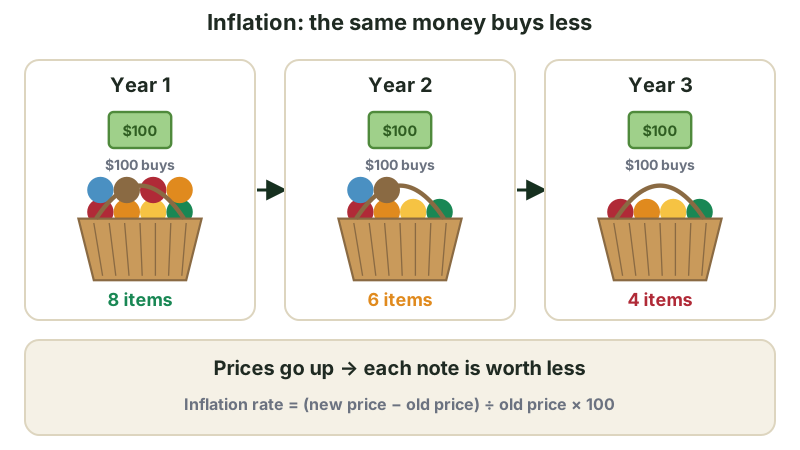
Have you heard someone say "when I was young, a loaf of bread cost just a few coins"? That's inflation: prices going up over time, so the same money buys less. Low, steady inflation is normal. But when inflation is high, families struggle to afford food and rent, and savings lose value fast. In 2025, South Sudan's inflation was close to 100%, according to IMF projections reported in the local media, meaning prices were roughly doubling in a year.
KEY WORDS
- Inflation: a general rise in prices over time.
- Inflation rate: how fast prices are rising, as a percentage per year.
- Purchasing power: how much your money can buy.
- Consumer price index (CPI): a measure of the price of a "basket" of things households usually buy.
- Deflation: when prices fall over time (rare).
HOW INFLATION IS MEASURED
Government statisticians track the prices of a typical "basket" of things households buy: food, fuel, rent, transport, clothes, school fees and so on. They compare the cost of the same basket each month or year.
Formula: inflation rate = (new price − old price) ÷ old price × 100
Example: the basket cost 10,000 last year and costs 10,800 this year.
- Increase: 10,800 − 10,000 = 800
- 800 ÷ 10,000 = 0.08
- 0.08 × 100 = 8% inflation
WHAT CAUSES INFLATION
- Too much money: if the amount of money grows faster than the goods being produced, prices rise. This is the main cause of very high inflation.
- Rising costs: when fuel, transport or imported goods get more expensive, businesses raise their prices to cover their costs.
- Strong demand: when lots of people want to buy more than businesses can produce, sellers can raise prices.
- A falling currency: if your currency loses value against the US dollar, imported goods such as fuel, medicine and cooking oil cost more. This is a big cause of inflation in countries that import much of what they use, such as South Sudan.
HOW INFLATION AFFECTS YOU
Your savings lose value. If you keep $100 at home and prices rise by 10% in a year, it will only buy about what $91 bought last year ($100 ÷ 1.10 = $90.91).
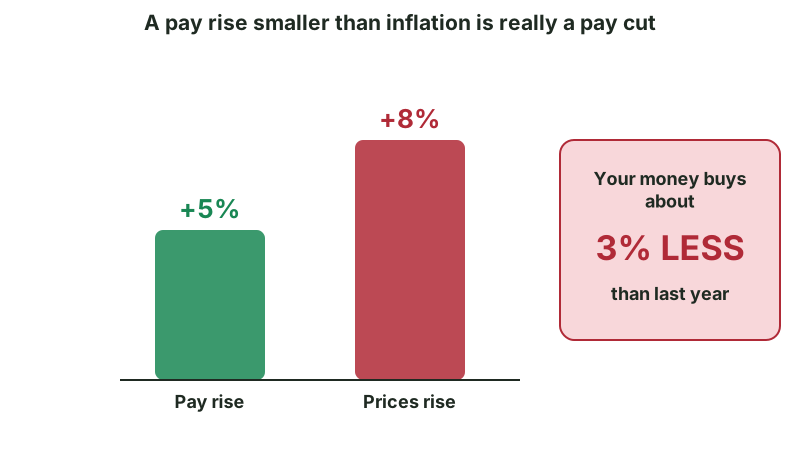
Your wages may fall in real terms. If your pay rises by 5% but prices rise by 8%, you can actually buy about 3% less than last year. Economists call this a fall in your "real wage".
THE RULE OF 70
To estimate how many years it takes for prices to double, divide 70 by the inflation rate.
- At 7% inflation: 70 ÷ 7 = 10 years for prices to double.
- At 2% inflation: 70 ÷ 2 = 35 years.
- At 35% inflation: 70 ÷ 35 = 2 years.
At close to 100% a year, as in South Sudan in 2025, prices roughly double within a single year.
WAYS FAMILIES PROTECT THEMSELVES
These are common approaches people use. They aren't personal financial advice, and the right choice depends on your situation.
- Keep savings in an account that pays interest, ideally at a rate close to or above inflation, rather than as cash at home.
- When inflation is high, avoid holding large amounts of a fast-falling currency for long. Some families buy useful goods they'll need anyway, such as bags of grain, when prices are lower.
- Ask for pay rises that keep up with inflation, and compare your pay rise with the inflation rate.
- Be careful with loans: when inflation is high, interest rates often rise too.
REAL-LIFE CASE STUDY GRACE'S SCHOOL FEES
Grace sells vegetables at a market. Last year she saved 120,000 at home to pay her daughter's school fees this year. But during the year, prices rose by 40%, and the school raised its fees by the same amount. The fees, which were 120,000, are now 120,000 × 1.4 = 168,000. Grace's savings didn't grow at all, so she is 48,000 short.
Her neighbour Mary saved the same amount in a savings group that paid interest and bought two bags of seed early in the year, before prices rose. When she planted and sold her crop, her income kept up better with rising prices.
The lesson: in times of high inflation, money kept as cash at home loses value quickly.
PRACTICE
Complete the sentences.
Drag a word into each gap, or tap a word and then tap the gap.
- A general rise in prices over time is called .
- How much your money can buy is its purchasing .
- Prices rising from 100 to 110 is an inflation rate of percent.
- When prices fall over time, it is called .
- To estimate how long prices take to double, divide by the inflation rate.
✓ Check Your Understanding
Pick one answer for each question. You'll see the explanation straight away.
1. A bag of rice cost 2,000 last year and costs 2,500 this year. What is the rate of inflation for rice?
2. Your pay goes up by 4%, but inflation is 10%. What has happened to your real wage?
3. Who is usually hurt most by high inflation?
4. Using the rule of 70, how long would it take prices to double at 5% inflation per year?
5. South Sudan imports much of its fuel, food and medicine. Why does a falling South Sudanese pound make prices rise?
You got out of 5. Excellent work! Read the explanations above, then try again.
Create a free account to tick off lessons and keep track of your progress.