← Back to Economics and Money Made Simple
Where Money Comes From: Central Banks and Commercial Banks
Your browser can't read text aloud. Try Chrome, Edge or Safari to hear the words.
WHY THIS MATTERS
Many people think banks lend out money that other customers have saved. That's only part of the story. In modern economies, most new money is created by ordinary commercial banks every time they make a loan. Understanding this explains how interest rates affect your loans and why printing too much money causes prices to rise.
KEY WORDS
- Central bank: the country's main bank, owned by the government, which issues the currency and manages the money supply. Examples: the Bank of South Sudan, the Bank of Uganda, the Central Bank of Kenya and the Reserve Bank of Australia.
- Commercial bank: an ordinary bank where people and businesses keep accounts and borrow money.
- Deposit: money held in your bank account.
- Loan: money you borrow and must pay back, usually with interest.
- Interest rate: the price of borrowing money, shown as a percentage per year.
TWO KINDS OF MONEY
Most money isn't cash at all.
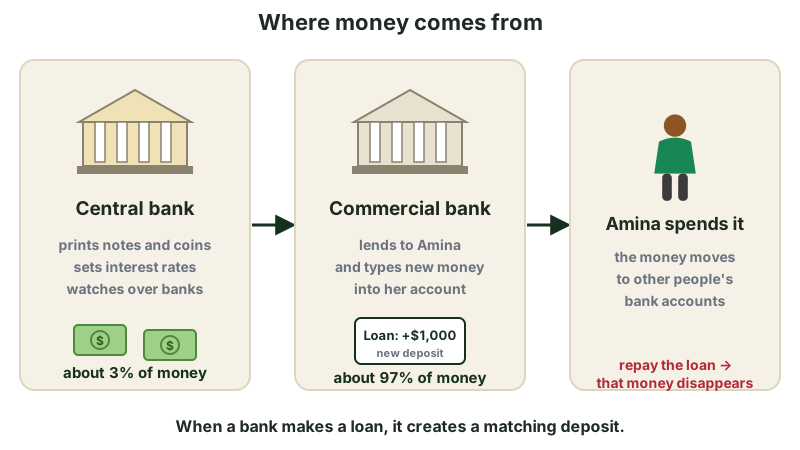
- Cash: notes and coins, issued by the central bank. In a country like the United Kingdom, this is only about 3% of the money people hold.
- Bank deposits: the numbers in bank accounts. About 97% of money in the UK is this kind of money.
Mobile money balances, such as M-Pesa, are backed by real money held in banks, so they move existing money around quickly rather than creating new money.
WHAT THE CENTRAL BANK DOES
- Issues the currency. It decides how many notes and coins to put into circulation.
- Sets the main interest rate. This affects how expensive it is for banks, and so for you, to borrow money.
- Acts as the bank for banks. Commercial banks keep accounts at the central bank and can borrow from it in an emergency.
- Keeps prices stable. Many central banks aim to keep inflation low and steady, for example around 2% to 3% a year.
HOW COMMERCIAL BANKS CREATE MONEY
Here's the surprising part. When a bank lends you money, it doesn't take cash out of a vault or out of someone else's account. It simply adds the amount to your account. The Bank of England puts it this way: whenever a bank makes a loan, it creates a matching deposit in the borrower's account.
Example: Amina borrows $1,000 from her bank to buy a sewing machine.
- The bank writes down a loan: Amina owes the bank $1,000.
- At the same moment, it types $1,000 into Amina's account. That $1,000 didn't exist before. It is new money.
- Amina pays the seller, and the money moves into the seller's bank account. It keeps circulating.
- When Amina pays the loan back, the money is cancelled and disappears from the economy.
WHAT STOPS BANKS CREATING UNLIMITED MONEY
- Banks must lend to people who can pay them back, or they lose money.
- Rules from the central bank require banks to hold enough of their own funds to cover losses.
- The central bank's interest rate: when it raises rates, loans cost more, so people borrow less and less new money is created.
- People must actually want to borrow.
WHEN GOVERNMENTS PRINT TOO MUCH MONEY
If a government pays its bills by creating huge amounts of new money, without more goods being produced, there is more money chasing the same amount of goods. Prices shoot up. In Zimbabwe in 2008, prices were doubling roughly every day at the worst point, and the central bank issued a 100 trillion dollar note that couldn't buy a loaf of bread for long. You'll learn more about this in the next lesson on inflation.
REAL-LIFE CASE STUDY JOSEPH'S BUSINESS LOAN
Joseph runs a small bakery and wants a second oven costing $3,000. The bank checks his business records and agrees to lend him the money at 18% interest per year. It adds $3,000 to his account, which is new money. Joseph pays the oven supplier, who pays her workers, who spend at the market. Joseph's bakery now makes twice as much bread, so he hires a helper. A year later, the central bank raises its interest rate because prices are rising fast. Joseph's bank raises his loan rate too, so his monthly repayments go up. He decides not to borrow for a third oven yet. This shows how central bank decisions travel through commercial banks to ordinary businesses.
PRACTICE
Complete the sentences.
Drag a word into each gap, or tap a word and then tap the gap.
- Notes and coins are issued by the bank.
- When a bank makes a loan, it creates a new in the borrower's account.
- Most money today is bank deposits, not .
- The price of borrowing money is the interest .
- When a loan is paid back, that money .
✓ Check Your Understanding
Pick one answer for each question. You'll see the explanation straight away.
1. Who issues a country's banknotes and coins?
2. When a commercial bank gives Amina a $1,000 loan, where does the money in her account come from?
3. In a modern economy like the UK's, roughly what share of money is notes and coins?
4. The central bank raises its main interest rate. What is the most likely effect?
5. What usually happens if a government prints huge amounts of money to pay its bills, without more goods being produced?
You got out of 5. Excellent work! Read the explanations above, then try again.
Create a free account to tick off lessons and keep track of your progress.