← Back to Economics and Money Made Simple
How Money Flows Round the Economy
Your browser can't read text aloud. Try Chrome, Edge or Safari to hear the words.
WHY THIS MATTERS
Have you noticed that when a big mine opens or a factory closes, the whole town feels it, from the market sellers to the bus drivers? That's because money flows in a circle. Every shilling, pound or dollar you spend becomes someone else's income, and they spend it again. Understanding this flow explains why recessions spread, why governments spend money to help the economy, and why buying local helps your community.
KEY WORDS
- Economy: all the buying, selling, making and working that happens in a place.
- Household: a person or family that earns income and spends it.
- Business (firm): an organisation that makes goods or provides services to sell.
- Income: money you receive, such as wages, profits or rent.
- Goods and services: things you can buy. Goods are objects (rice, phones); services are work done for you (a haircut, a bus ride).
THE CIRCULAR FLOW
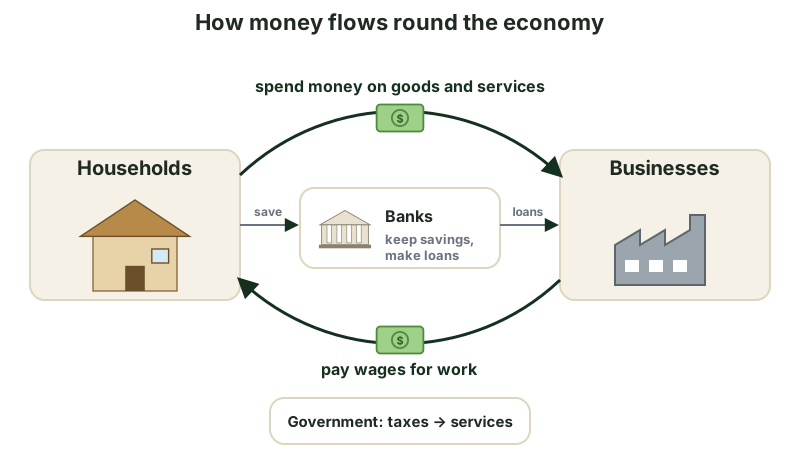
The simplest picture of an economy has two groups:
- Households work for businesses, and businesses pay them wages.
- Households spend those wages buying goods and services from businesses.
- Businesses use that money to pay wages again, and the circle continues.
MONEY LEAVING AND JOINING THE CIRCLE
Real economies are more complicated. Some money leaves the circle, and some joins it.
Money leaves the circle when people:
- Save it in a bank or under the mattress instead of spending it.
- Pay taxes to the government.
- Buy imported goods, because the money goes to businesses in another country.
Money joins the circle when:
- Banks lend money to businesses and households to spend or invest.
- The government spends on roads, schools, hospitals and salaries.
- People in other countries buy our exports, such as oil, gold, coffee or cattle.
If more money joins than leaves, the economy grows. If more leaves than joins, the economy shrinks.
THE MULTIPLIER WHY SPENDING SPREADS
Imagine a new road project pays a builder $100. The builder spends $80 of it at the market and saves $20. The market seller then spends $64 of that $80 on school fees and saves $16. The school spends $51.20 on salaries, and so on.
Each time, the money keeps moving, a little smaller each round. Add up all the rounds, and that first $100 creates about $500 of spending in total.
Quick formula: total spending = first amount ÷ (the part each person saves)
- Here each person saves 20%, or 0.2. So $100 ÷ 0.2 = $500.
This is called the multiplier. It works in reverse too: when a big employer closes, the loss of spending spreads through the whole community.
WHY BUYING LOCAL HELPS
When you buy tomatoes from a local farmer, the money stays in your area: the farmer pays a local worker, who buys bread from a local baker. When you buy imported goods, much of the money leaves the country. Imports are not bad, since they bring things we can't make ourselves, but local spending keeps more money circulating at home.
REAL-LIFE CASE STUDY THE GOLD MINE TOWN
When a new gold mine opened near a small town, it hired 300 local workers. Those workers spent their wages in town. Food sellers and shops had more customers, so they hired helpers. Bus companies added routes to take workers to the mine. New guesthouses opened for visitors. A few years later, gold prices fell and the mine cut half its workers. Within months, shops lost customers, some guesthouses closed, and the bus company cut routes, even though none of them worked at the mine. This is the circular flow and the multiplier in action, both on the way up and on the way down.
PRACTICE
Complete the sentences.
Drag a word into each gap, or tap a word and then tap the gap.
- Businesses pay households for their work.
- Money you put aside instead of spending is called .
- Goods bought from another country are called .
- Goods sold to another country are called .
- One person's spending is another person's .
✓ Check Your Understanding
Pick one answer for each question. You'll see the explanation straight away.
1. In the simple circular flow, what do households give businesses?
2. Which of these takes money out of the local circular flow?
3. A road project pays a worker $1,000. Everyone who receives the money spends 75% of it and saves 25%. About how much total spending does the first $1,000 create?
4. A large factory closes. Why do shops in the town also lose business?
5. Why does buying from local producers help a community's economy?
You got out of 5. Excellent work! Read the explanations above, then try again.
Create a free account to tick off lessons and keep track of your progress.